Combining surgery, targeted therapy, and multidisciplinary management is expanding treatment options for patients with plexiform neurofibromas, particularly those with complex tumors.

This was highlighted by medical experts during a scientific seminar on the management of patients with neurofibromatosis type 1-associated plexiform neurofibromas (NF1-PN), hosted by Tam Anh General Hospital Group on September 25, 2026.
In his opening remarks, Assoc. Prof. Tran Quang Binh, MD, PhD, Medical Director of Tam Anh General Hospital Group in Ho Chi Minh City, stated that NF1 is a rare disease with complex manifestations affecting multiple organs. Therefore, patients may require long-term monitoring and treatment involving multiple medical specialties.
NF1 is a genetic disorder caused by mutations in the NF1 gene, affecting approximately one in 3,000 people. Plexiform neurofibromas (PN) occur in approximately 20% to 50% of patients with NF1. These tumors can grow along nerves and extend into surrounding tissues, causing pain, disfigurement, or functional impairment depending on their location and progression.
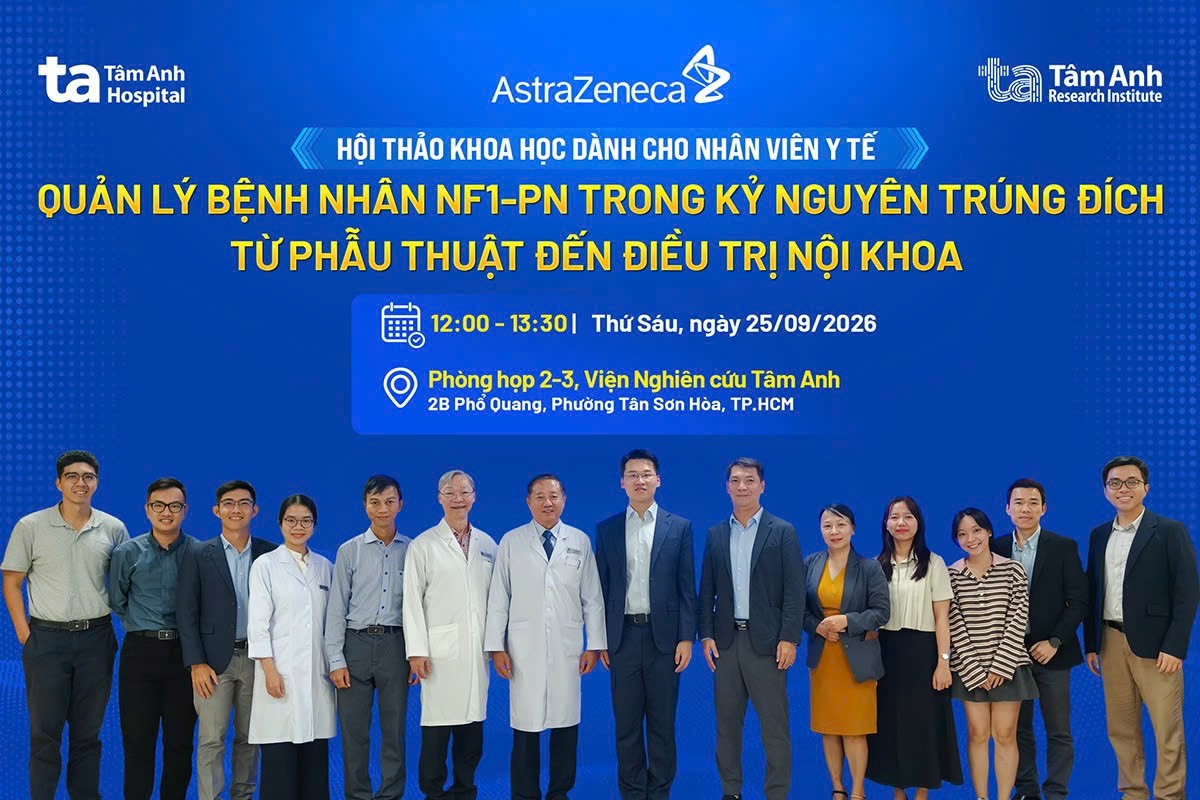
Experts and physicians attending the scientific meeting.
Multidisciplinary coordination in NF1-PN management
Prof. Zhichao Wang, MD, PhD, from Shanghai Ninth People’s Hospital, Shanghai Jiao Tong University School of Medicine, China, noted that NF1-PN can occur in various locations, from the head, face, and orbits to the spine, mediastinum, and extremities. Because these tumors grow along nerves and can extend across multiple anatomical regions, treatment must balance tumor control with preservation of function.
At Shanghai Ninth People’s Hospital, patients with NF1-PN are managed through a multidisciplinary approach involving plastic surgery, pediatrics, neurosurgery, neurology, orthopedics, oncology, radiology, pathology, and other relevant specialties. The multidisciplinary team jointly evaluates the tumor’s location, extent, growth rate, symptoms, and functional impact to determine whether continued monitoring, surgery, medical therapy, or a combination of approaches is appropriate.

Prof. Zhichao Wang, MD, PhD, delivers a presentation and shares his experience at the scientific meeting.
According to Prof. Wang, MRI plays an important role in the evaluation and monitoring of PN, particularly for deep-seated or extensive lesions that are difficult to fully assess on physical examination. When malignant transformation is suspected, histopathology is the diagnostic standard.
Treatment effectiveness is not assessed solely by tumor size. Prof. Wang’s team combines changes in tumor volume on 3D imaging with symptoms, function, and quality of life. Depending on the individual case, targeted therapy may be combined with surgery at different stages to both control the tumor and address lesions that affect function. This approach expands treatment options rather than considering surgery and medical therapy as separate approaches.
The role of surgery in NF1-PN treatment
Mai Hoang Vu, MD, MSc, from the Department of Neurosurgery and Spine, Neuroscience Center, Tam Anh General Hospital in HCMC, explained that PN can cause pain, disfigurement, limited mobility, vision loss, airway compression, spinal cord compression, and impaired bowel or bladder function. Patients with NF1 also have an estimated lifetime risk of 8% to 13% of developing malignant peripheral nerve sheath tumors.
Surgery plays an important role in treating tumors that cause symptoms, show progression, or impair function. However, PN often grows along multiple nerve bundles, extends into surrounding tissues, or lies close to critical structures. Therefore, surgeons must carefully balance the goal of tumor removal with preservation of neurological function.

Dr. Mai Hoang Vu presents a report on the role of surgery in the treatment of NF1-PN at the scientific meeting.
Dr. Vu shared the case of a 32-year-old woman with NF1 who experienced progressively worsening right-sided numbness and weakness over two months, resulting in difficulty walking. Upon admission, muscle strength was 3/5 in the right arm and 4/5 in the right leg. MRI revealed an intraspinal tumor at C2-C3 that significantly compressed the cervical spinal cord.
The surgical team performed a laminectomy and completely removed the tumor originating from the right C3 nerve root under intraoperative neurophysiological monitoring. Histopathological examination confirmed a neurofibroma. After surgery, the patient developed no new neurological deficits, her muscle strength improved, and she was able to walk. Follow-up MRI showed decompression of the cervical spinal cord, with no mass lesion identified.
However, not all PN can be completely resected. According to Dr. Vu’s report, approximately half of PN cases may fall into the category of tumors that cannot be completely removed if surgery carries a significant risk of injury. Tumors may also recur after intervention. Therefore, patients require evaluation to determine the appropriate timing of surgery, followed by long-term monitoring.
Targeted therapy expands treatment options
Nguyen Hoang Mai Anh, MD, Head of the Clinical Hematology Department at Children’s Hospital City, stated that the development of MEK inhibitors has expanded treatment options for children with symptomatic NF1-PN that cannot be completely removed surgically.
Selumetinib inhibits MEK in the RAS-RAF-MEK-ERK signaling pathway, thereby limiting signals that promote abnormal cell proliferation and potentially reducing PN volume in some patients.
In the Phase II SPRINT trial involving 50 children with NF1-PN that could not be surgically removed, 68%, or 34 patients, achieved a confirmed partial response, defined as a reduction of at least 20% in target tumor volume. Among responders, 56% maintained the response for more than one year at the time of data analysis.
The reduction in tumor volume was also accompanied by improvements in some symptoms, including pain and limited mobility. However, patients require long-term treatment and monitoring. Reported side effects included vomiting, diarrhea, nausea, paronychia, acneiform rash, and elevated muscle enzymes, most of which were mild to moderate in the presented study.

Dr. Nguyen Hoang Mai Anh delivers a presentation at the scientific meeting.
Dr. Mai Anh shared the case of a pediatric patient with NF1-PN who has been receiving selumetinib since 2020. During several years of follow-up, the medical team conducted multiple consultations with international experts to evaluate treatment response, consider the appropriate duration of treatment, and develop a long-term monitoring plan.
Experts agree that NF1-PN requires an individualized, multidisciplinary, and multimodal management approach. Depending on tumor location, symptoms, and the risk of functional impairment, patients may undergo monitoring, medical therapy, surgery, or a combination of different treatment approaches. The treatment goal is not only to reduce tumor size but also to relieve pain, preserve function, and improve quality of life.
The scientific seminar, organized by Tam Anh General Hospital Group, provided a forum for domestic and international experts to exchange experience and share updates on advances in the management and treatment of NF1-PN.
Tam Anh Research Institute
- Ha Noi:
- 108 Hoang Nhu Tiep, Bo De Ward, Ha Noi
- Hotline: 024 3872 3872 – 024 7106 6858
- TP.HCM:
- 2B Pho Quang Street, Ward Tan Son Hoa, Ho Chi Minh City
- Hotline: 093 180 6858 – 0287 102 6789
- Fanpage: https://www.facebook.com/ViennghiencuuTamAnh.TAMRI
- Website: tamri.vn