On October 1, 2026, the Tam Anh General Hospital Group in Ho Chi Minh City hosted a scientific seminar titled “Optimizing the treatment of common upper gastrointestinal diseases,” providing updates on clinical knowledge and practical experience while discussing diagnostic and treatment strategies aimed at personalized patient care.

Assoc. Prof. Dr. Tran Quang Binh (center), a representative of the sponsor, and speakers at the scientific seminar on October 1.
In his opening remarks, Assoc. Prof. Dr. Tran Quang Binh, Medical Director of Tam Anh General Hospital in Ho Chi Minh City, said that upper gastrointestinal diseases are a group of conditions affecting the upper part of the digestive tract, primarily the esophagus, stomach, and duodenum. These conditions may involve structural lesions such as inflammation, ulcers, bleeding, or tumors, as well as functional disorders. In some cases, patients may experience gastrointestinal symptoms without corresponding structural abnormalities being detected through diagnostic evaluations.
At the seminar, experts focused on two practical issues in the management of upper gastrointestinal diseases: the appropriate clinical use of proton pump inhibitors (PPIs) and the management of overlapping gastroesophageal reflux disease (GERD) and functional dyspepsia (FD).
In clinical practice, GERD and functional dyspepsia are two common gastrointestinal conditions. They may occur simultaneously in the same patient, resulting in overlapping symptoms and making it more challenging to identify the mechanisms underlying the symptoms and select an appropriate treatment approach.
Rational and Indication-based PPI use
Opening the scientific session, Dr. Le Thanh Quynh Ngan, Head of the Department of Gastroenterology, Center for Endoscopy and Endoscopic Gastrointestinal Surgery, presented the topic “Rational use of PPIs in clinical practice.”
Proton pump inhibitors (PPIs) are an important class of medications used to treat acid-related disorders, including GERD, peptic ulcer disease, and as part of Helicobacter pylori (H. pylori) eradication regimens. PPIs may also be used to prevent upper gastrointestinal injury in certain high-risk patients.

Dr. Le Thanh Quynh Ngan emphasized that the effectiveness of PPIs depends on the indication, dosage, and method of use.
According to Dr. Quynh Ngan, the effectiveness of PPIs depends on the indication, dosage, and method of use. For many PPI medications, the drug is generally taken 30-60 minutes before meals as directed by a physician. Patients should not increase the dosage or extend the treatment duration on their own when symptoms remain uncontrolled without undergoing medical re-evaluation.
Treatment duration depends on the underlying condition, severity of the lesions, and individual patient response. For example, uncomplicated peptic ulcer disease generally requires approximately 4-8 weeks of treatment, while H. pylori eradication regimens typically last around 14 days, depending on the individual patient. For functional dyspepsia, PPIs may be considered for an appropriate period, followed by an assessment of the treatment response. Some patients with complicated GERD or specific medical conditions may require long-term maintenance therapy as prescribed by a physician.
After the initial treatment period, patients should be reassessed to determine whether continued PPI therapy is necessary. If symptoms are controlled and there is no longer an indication for maintenance therapy, physicians may consider reducing the dosage, using the medication as needed, or discontinuing it, depending on the individual case.
Patients should not stop taking PPIs on their own, particularly after prolonged use. Some patients may experience rebound acid hypersecretion after discontinuation, resulting in short-term symptoms such as heartburn, a burning sensation, or dyspepsia. When discontinuation is necessary after long-term treatment, physicians may provide guidance on a tapering plan or appropriate measures to manage symptoms.
Concerns about potential adverse effects of PPIs should also not be a reason for patients to stop treatment on their own when an indication for therapy remains. Physicians should assess the benefits and risks in each individual case and select the lowest effective dose and an appropriate treatment duration based on the indication.
GERD and functional dyspepsia overlap
Building on the discussion of appropriate medication use, the seminar then addressed a common challenge in clinical practice: the overlap between GERD and functional dyspepsia. This topic was presented by Dr. Nguyen Thi Ngoc Bich from the Department of Gastroenterology, Center for Endoscopy and Endoscopic Gastrointestinal Surgery, under the topic “Management of GERD and functional dyspepsia overlap.”
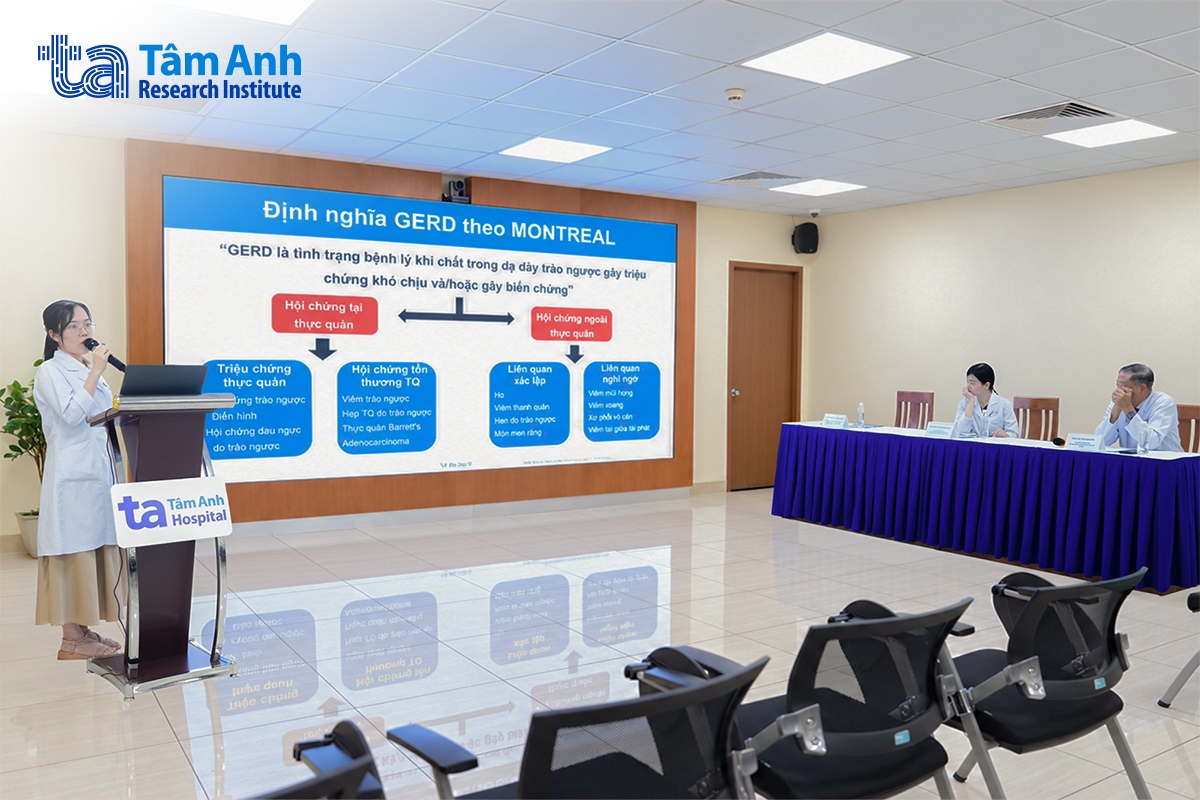
Dr. Nguyen Thi Ngoc Bich presents on the common clinical challenge of overlapping GERD and functional dyspepsia.
Functional dyspepsia commonly presents with symptoms such as postprandial fullness, early satiety, epigastric pain, or epigastric burning. GERD, meanwhile, commonly causes heartburn and regurgitation, while some patients may experience non-cardiac chest pain or extraesophageal symptoms.
The pathophysiology of functional dyspepsia is complex and may involve impaired gastric accommodation, motility disorders, visceral hypersensitivity, and gut-brain interactions. GERD, meanwhile, is associated with the reflux of gastric contents into the esophagus, the protective capacity of the esophageal mucosa, and individual patient sensitivity.
When GERD and functional dyspepsia coexist, symptoms may arise from multiple mechanisms. As a result, some patients may experience only partial improvement when treated according to a single mechanism. In such cases, physicians need to assess symptom characteristics, treatment response, and risk factors to determine an appropriate management approach rather than simply increasing the medication dosage.
Personalized treatment, not just dose escalation
In patients with overlapping GERD and functional dyspepsia, treatment may be more complex because symptoms can be associated with multiple mechanisms. PPIs play a role in controlling acid- and reflux-related symptoms but may not fully address symptoms caused by functional dyspepsia.

Dr. Ta Phuong Dung, Deputy Director of the Department of Urology – Nephrology – Andrology and Head of the Department of Nephrology – Dialysis at Tam Anh General Hospital in HCMC, speaks with the presenters at the scientific seminar.
Therefore, treatment strategies should be based on symptom phenotype, underlying pathophysiology, and individual patient response. Following assessment, physicians may select or combine appropriate approaches, such as PPIs when indicated, prokinetic medications in certain cases, or visceral pain neuromodulators when appropriate to the patient’s symptoms and characteristics.
The goal of treatment is not only to control symptoms but also to limit prolonged medication use when it is unnecessary. When patients continue to experience symptoms after treatment, physicians should reassess the diagnosis, treatment response, adherence, and potential mechanisms underlying the symptoms before deciding whether to modify or intensify the treatment regimen.
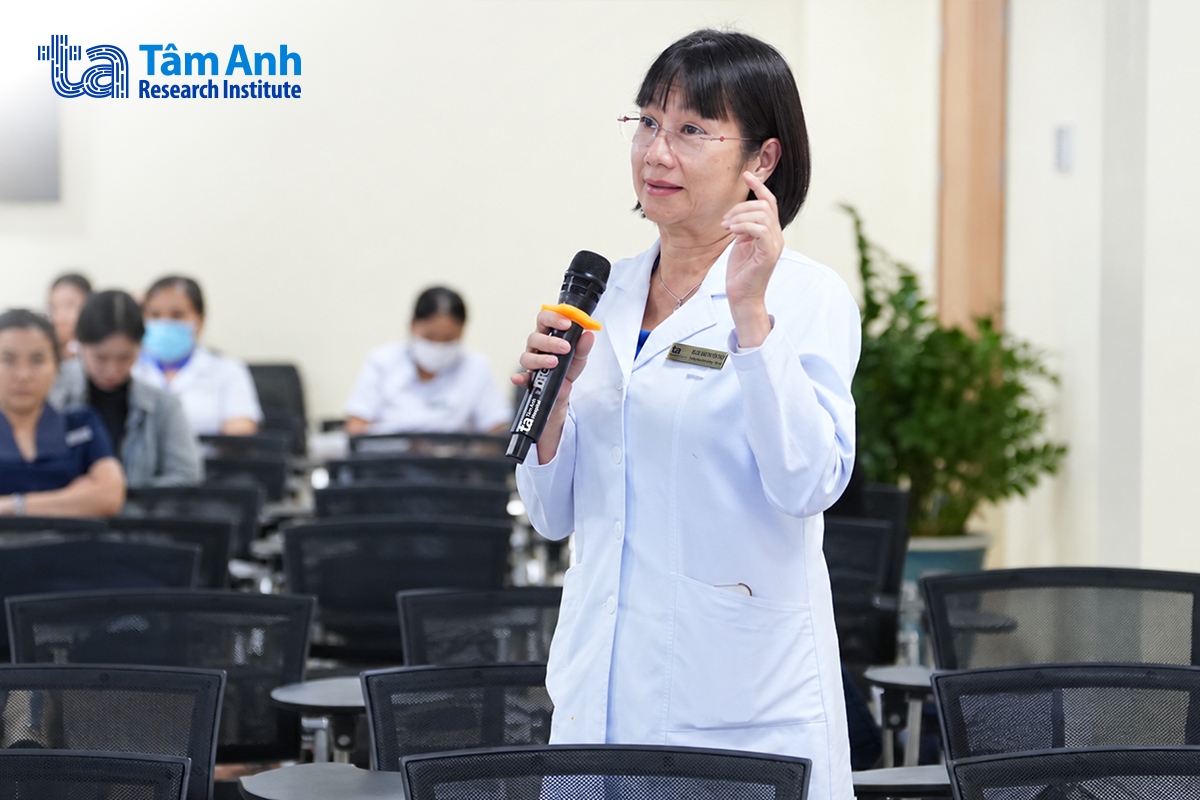
Dr. Dao Thi Yen Thuy, Head of the Department of Nutrition and Dietetics at Tam Anh General Hospital in HCMC, speaks at the scientific seminar.
The scientific seminar “Optimizing the treatment of common upper gastrointestinal diseases” attracted nearly 100 specialists, physicians, and healthcare professionals who gathered to exchange knowledge and share practical experience. The program contributed to academic exchange, updates in clinical knowledge, and the application of multi-mechanistic approaches to the management of upper gastrointestinal diseases.
Through these discussions, physicians gain a stronger basis for accurately identifying diseases, determining the mechanisms underlying symptoms, and selecting appropriate treatment strategies aimed at effective symptom control while limiting unnecessary long-term medication use.
Tam Anh Research Institute
- Ha Noi:
- 108 Hoang Nhu Tiep, Bo De Ward, Ha Noi
- Hotline: 024 3872 3872 – 024 7106 6858
- TP.HCM:
- 2B Pho Quang Street, Ward Tan Son Hoa, Ho Chi Minh City
- Hotline: 093 180 6858 – 0287 102 6789
- Fanpage: https://www.facebook.com/ViennghiencuuTamAnh.TAMRI
- Website: tamri.vn