On the morning of October 31, at Tam Anh Research Institute, Tam Anh General Hospital HCMC held the international workshop “Robotic Surgery in Head and Neck Cancer” convened leading domestic and international experts to exchange experiences and update advancements in applying the Da Vinci Xi robotic system for the treatment of Head and Neck Cancer.

This workshop served as a pre-conference event for the 9th Asian Congress of Head and Neck Surgery and the 28th National Congress of Otorhinolaryngology – Head and Neck Surgery, scheduled to take place on November 1–2, 2025, in Ho Chi Minh City, Vietnam.
The “Robotic Surgery in Head and Neck Cancer” workshop featured participation from leading experts in Otorhinolaryngology:
- Prof. Tran Phan Chung Thuy, MD, PhD, President of the Vietnam Society of Otorhinolaryngology, former President of the ASEAN Otorhinolaryngological Head and Neck Federation, and Director of the Otorhinolaryngology Center, Tam Anh General Hospital System HCMC.
- Prof. Yoon Woo Koh, MD, PhD, Secretary General of the International Robotic and Endoscopic Head and Neck Surgery Society, Chairman of the Department of Otorhinolaryngology, and Director of the Head and Neck Cancer Center, Yonsei University College of Medicine, Seoul, South Korea.
- Dr. Chih-Chun Wang, Director of Head and Neck Surgery, Department of Otorhinolaryngology, and Deputy Director of the Cancer Center, E-Da Hospital, Taiwan.
- Dr. Vo Tan Dan, Otorhinolaryngology and Head and Neck Surgeon, Orléans Central University Hospital, France.
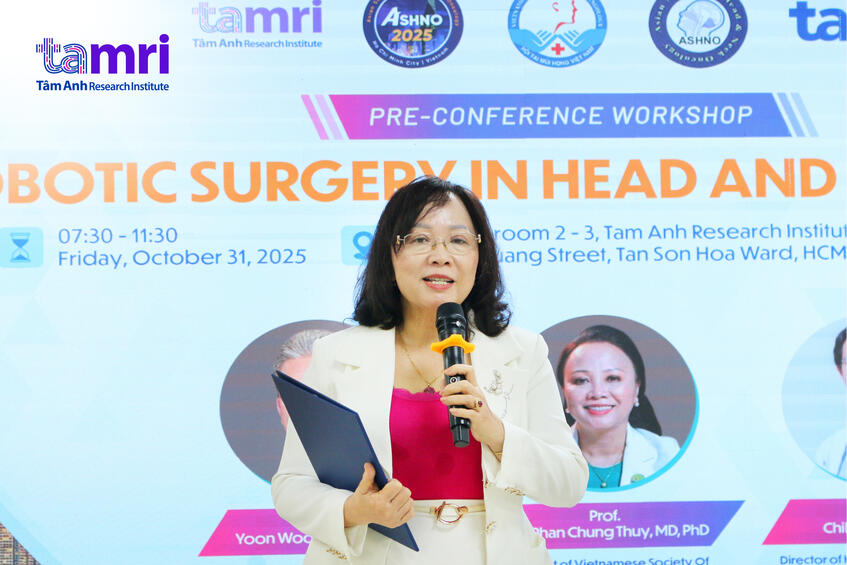
Prof. Dr. Tran Phan Chung Thuy, President of the Vietnam Otolaryngology Association and Director of the Otolaryngology Center at Tam Anh General Hospital in Ho Chi Minh City, delivers the opening speech at the conference. Photo: Tam Anh General Hospital.
Opening the workshop, Prof. Tran Phan Chung Thuy, President of the Vietnam Society of Otorhinolaryngology and Director of the Otorhinolaryngology Center at Tam Anh General Hospital HCMC, expressed sincere gratitude to the domestic and international experts and doctors for attending, sharing professional experience, and exchanging updates on advancements in robotic technology for Head and Neck Cancer treatment.
Following the opening, Prof. Tran Phan Chung Thuy, MD, PhD, presented a report titled: “Anatomical Understanding of the Laryngeal Region: An Inside-Out Approach.” Through the report, Prof. Chung Thuy provided in-depth analysis of anatomical structures and their application in Head and Neck surgery to maximize the precision, safety, and effectiveness of surgical treatment, especially for laryngeal cancer cases.

Prof. Chung Thuy presents the topic: “Updated Insights into Laryngeal Anatomy from the Inside Out.” Photo: Tam Anh General Hospital.
Prof. Chung Thuy provided specific visual illustrations of the anatomical structure of the pharyngeal wall layers, from the mucosa to the outer muscle layer (the inside-out method). This helped identify dangerous vascular and nerve areas during laryngeal surgery, recognize anatomical landmarks, assess bleeding risks, and apply imaging and hemostasis strategies in practice. The presentation also highlighted the relationship between anatomical compartments, dissection planes, and oncological margins to ensure surgeons operate accurately and safely, avoiding complications and minimizing risks.
“When performing surgery in the laryngeal region using the inside-out approach, surgeons need to plan layer by layer, ensure early control of the tonsillar and lingual arteries, and avoid excessive dissection outside the pharyngeal constrictor muscle. Preoperative imaging makes the operation safer. Confusion about depth or plane poses a risk of uncontrolled bleeding,” Prof. Chung Thuy emphasized.
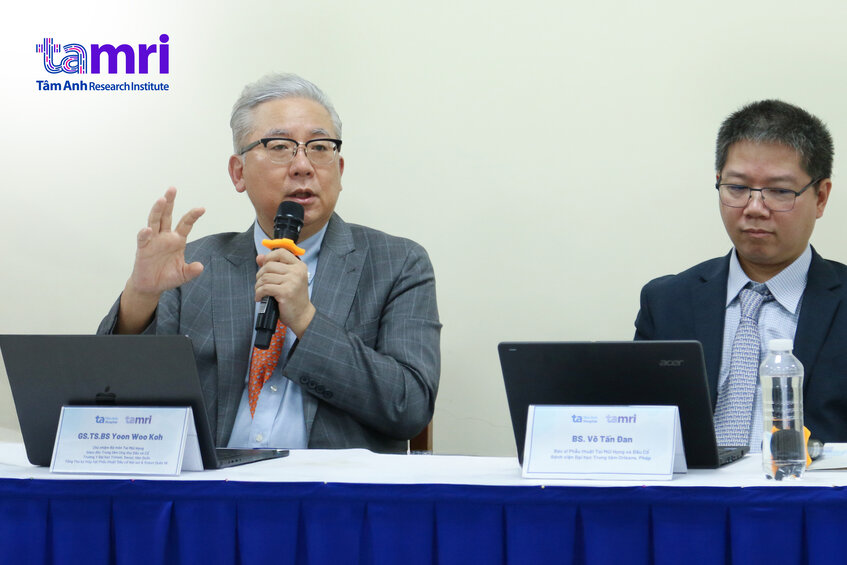
Prof. Dr. Yoon Woo Koh, Secretary-General of the International Robotic and Endoscopic Head and Neck Surgery Association; Head of Otolaryngology and Director of the Head and Neck Cancer Center, Yonsei University College of Medicine, Seoul, Korea, shares expertise at the conference. Photo: Tam Anh General Hospital.
Following Prof. Chung Thuy’s report, Prof. Yoon Woo Koh, MD, PhD, presented the principles and updated advancements in partial/total laryngectomy through his reports: “SCL – CHEP/CHP and TL (Larynx Preservation or Ablation) Surgery in Laryngeal Cancer Treatment” and “Evolution of Parapharyngeal Space Tumors and Retropharyngeal Lymph Node Dissection Surgery in the Robotic Head and Neck Era.” These presentations provided practical and useful information for the clinical work of the specialists.
The workshop became more engaging as attending experts and doctors watched a video recording of Prof. Yoon Woo Koh performing Head and Neck cancer surgeries using the Da Vinci Xi robot. The footage demonstrated the robot arms operating meticulously, skillfully, and accurately, dissecting tumors in the laryngeal region under the expert and subtle control of Prof. Yoon. Patients benefit from smaller, more aesthetically pleasing incisions, less pain, and quicker recovery times, while simultaneously reducing the risk of postoperative complications compared to traditional open surgery.
The Da Vinci Xi Robot is currently the world’s leading advanced surgical technology, regarded as a “long extension arm” for the surgeon. The 4th generation Da Vinci Xi Robot—the latest generation with top-tier modern features—is now available at Tam Anh General Hospital HCMC and has been applied in surgery to treat over 120 diseases across urology, gastroenterology, cardiology, and thoracic specialties.
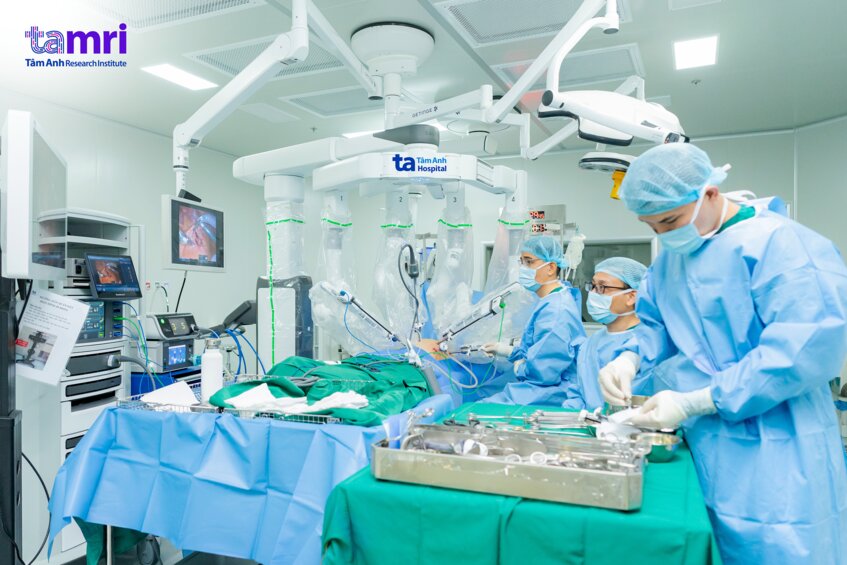
Doctors at Tam Anh General Hospital performing surgery with the world’s most advanced Da Vinci Xi robotic system. Photo: Tam Anh General Hospital.
The latest generation Da Vinci Xi Robot is considered a revolution in minimally invasive surgery due to its outstanding effectiveness. With robotic arms mimicking human wrist movements, a $540$-degree rotation capability, flexible maneuvering in narrow spaces, integrated high-definition 3D imaging magnified 15 times, and an absolutely precise control system, the Da Vinci Xi Robot assists doctors in operating on complex cancers. Surgeons can perform delicate manipulations in narrow spaces, minimize damage to healthy tissues, and shorten recovery time for patients.
The Da Vinci Xi Robot is also integrated with a sealing and hemostasis handle, allowing for tissue cutting and immediate bleeding control without changing instruments.
The Da Vinci Xi Robot is currently routinely applied at Tam Anh Hospital for multispecialty treatments in Urology, Head and Neck, Gastroenterology, Obstetrics, etc. In the coming time, the Da Vinci Xi Robot will be applied more broadly in the Otorhinolaryngology department at Tam Anh General Hospital HCMC to treat laryngeal cancer, nasopharyngeal cancer, parotid gland tumors, and other Head and Neck tumors.
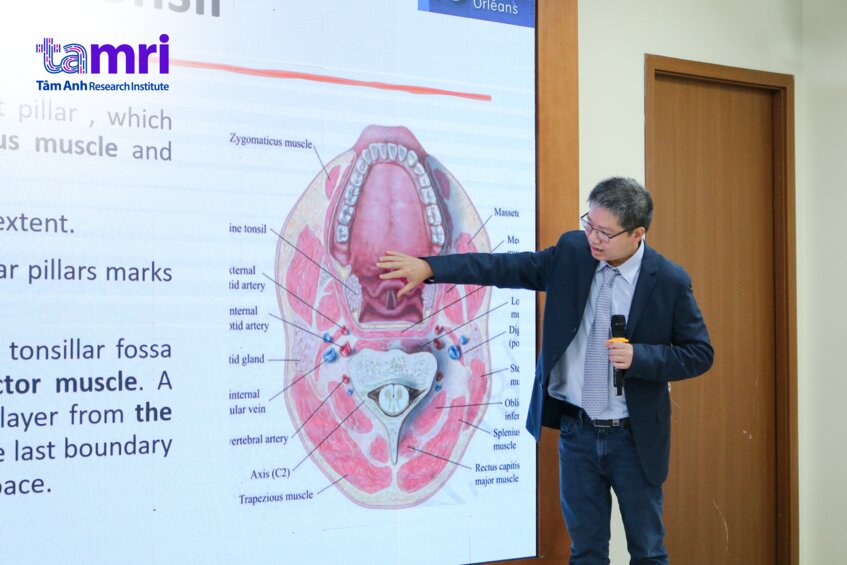
Dr. Vo Tan Dan, Otolaryngology and Head & Neck Surgeon, Orleans University Hospital (France), presenting at the conference. Photo: Tam Anh General Hospital.
Also related to robotic applications, Dr. Vo Tan Dan, Otorhinolaryngology and Head and Neck Surgeon at Orléans Central University Hospital (France), provided updates on anatomical structure and practical experience through his presentation “Transoral Robotic Oropharyngectomy using the Da Vinci Robotic System” at the workshop.
Dr. Dan provided a detailed analysis of the surgical procedure and demonstrated actual cases performed at Orléans Central University Hospital (France), giving colleagues a visual understanding of the advantages of the Da Vinci robot in accessing and treating intricate oropharyngeal lesions precisely and minimally invasively.
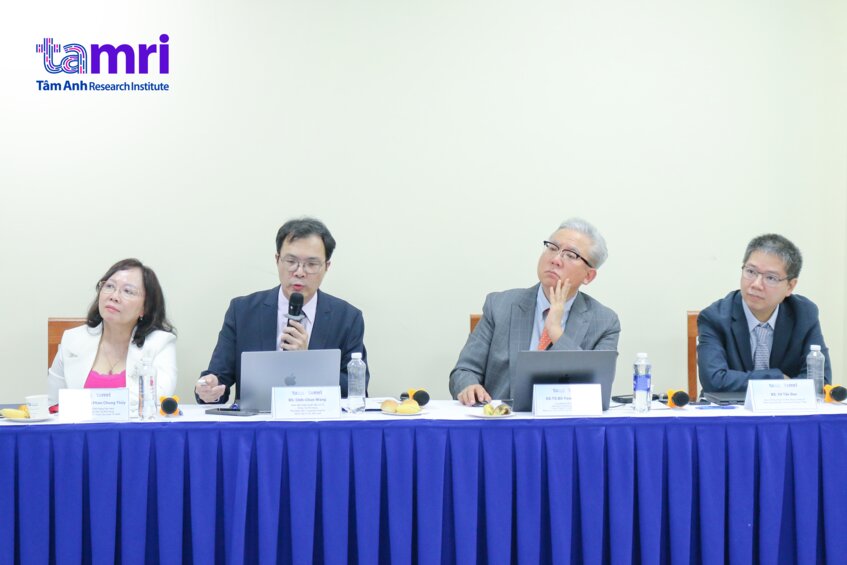
Dr. Chih-Chun Wang (second from left), Head of Head and Neck Surgery, Otolaryngology Department; Deputy Director of the Cancer Center, E-Da Hospital, Taiwan, delivers his report at the conference.
Towards the end of the workshop, the presentation by Dr. Chih-Chun Wang, Director of Head and Neck Surgery, Department of Otorhinolaryngology, and Deputy Director of the Cancer Center, E-Da Hospital, Taiwan, titled: “From TORS to BABA: Expanding the Limits of Robotic Head and Neck Surgery,” provided attendees with many impressive and intriguing insights.
Through Transoral Robotic Surgery (TORS), doctors can effectively access and manage tumors in the oropharynx, base of the tongue, and larynx through the mouth without external skin incisions. Building on this success, the Bilateral Axillo-Breast Approach (BABA) technique allows surgeons to operate through incisions in the armpits and bilateral areola, eliminating neck scars and enhancing postoperative aesthetics.
Dr. Chih-Chun Wang also screened and demonstrated actual surgeries he performed using the Da Vinci robotic system via the axillary and bilateral areola approach. Fellow doctors were able to visually observe the procedures. In these cases, patients had absolutely no neck scars, only a small incision of about 2cm in the armpit area. The incision healed quickly, ensuring high aesthetic satisfaction for the patients post-surgery.
Robotic technology is not confined to one area (such as the pharynx-mouth) but is expanding to many other regions of the Head and Neck, such as the thyroid and deep neck areas. Robotic surgery is continuously pushing the boundaries of the Head and Neck specialty, enhancing precision, safety, and aesthetics in surgery.

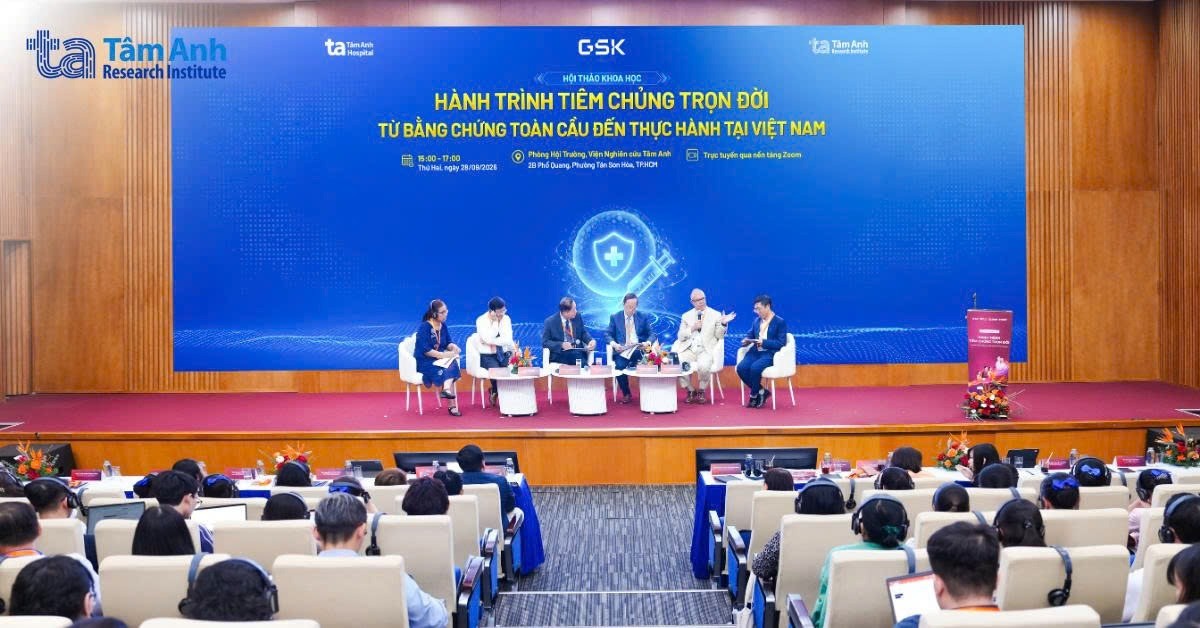
The workshop attracted many experts and doctors participating both in-person and online via the Zoom system. Photo: Tam Anh General Hospital.
Also at the workshop, Dr. Chih-Chun Wang shared his experience in recording surgical cases with beautiful, clear image quality and high academic value, making it easier for doctors to observe and exchange expertise. In addition to his role as a doctor and surgeon, Dr. Wang is also a photographer. Therefore, he pays meticulous attention to camera angles, lighting, and recording equipment to ensure that each surgical video is not only medically valuable but also accurate and aesthetic, serving domestic and international training and surgical experience sharing.

Doctors attending the conference pose for a souvenir photo after the event. Photo: Tam Anh General Hospital.
The workshop attracted a large number of domestic and international experts and doctors participating both in-person and online via the Zoom system. The event delivered a wealth of specialized knowledge and practical experience, helping doctors update the latest advancements in robotic surgery in the Head and Neck field. This knowledge will be applied in examination and treatment at their respective medical units, aiming to bring the highest benefit to patients.
Tam Anh Research Institute
- Ha Noi:
- 108 Hoang Nhu Tiep, Bo De Ward, Ha Noi
- Hotline: 024 3872 3872 – 024 7106 6858
- TP.HCM:
- 2B Pho Quang Street, Ward Tan Son Hoa, Ho Chi Minh City
- Hotline: 093 180 6858 – 0287 102 6789
- Fanpage: https://www.facebook.com/ViennghiencuuTamAnh.TAMRI
- Website: tamri.vn