Digital transformation in Central Sterile Services Department (CSSD) management not only helps optimize operations but also contributes to infection prevention at its source, enhancing patient safety and improving treatment quality.
These insights were shared by domestic and international experts at the scientific symposium “Digitalization trends in CSSD management,” organized by the Tam Anh Research Institute in collaboration with Tam Anh General Hospital Ho Chi Minh City on June 1. The event brought together experts in infection prevention and control, healthcare management, and CSSD operations from Vietnam and abroad.
The symposium brought together experts in infection prevention and control, healthcare management, and CSSD operations.
The symposium focused on emerging challenges and trends in CSSD management while reaffirming the role of digital transformation in improving treatment quality, strengthening infection control, and ensuring patient safety.
CSSD – The “Silent Heart” behind every surgery
In his opening remarks, Assoc. Prof. Pham Hung Cuong, MD, PhD, Deputy Medical Director in charge of Surgical Services at Tam Anh General Hospital Ho Chi Minh City, emphasized that while the operating room determines the success of a surgical procedure, CSSD serves as the “silent heart” safeguarding patient safety behind the scenes.
According to Dr. Cuong, amid the rapid wave of digital transformation, CSSD is no longer simply a support unit responsible for processing medical instruments. Instead, it is evolving into an intelligent management system that plays a central role in a hospital’s patient safety strategy.
“Digitalization is not about transferring existing processes onto a computer. It should be seen as an opportunity to review, identify, and eliminate infection risks at their root cause,” he stressed.

Assoc. Prof. Pham Hung Cuong, MD, PhD (right), presents a certificate of appreciation to Ms. Norlidah Othman.
According to Ms. Norlidah Othman – a CSSD management specialist at Epworth Richmond Hospital in Melbourne, Australia, the ultimate goal of CSSD is to ensure that every patient receives safe care under the same quality standards, regardless of the department in which they are treated.
She noted that CSSD has traditionally been viewed as a logistics unit supporting clinical services. However, in modern hospital systems, CSSD should be recognized as an essential safety infrastructure with a direct impact on treatment outcomes and patient care quality. Its effectiveness should not be measured solely by operating costs, but also by the infection risks and medical incidents it helps prevent.

Ms. Norlidah Othman shares her experience and insights at the symposium.
To build a modern CSSD system, experts highlighted three key pillars:
Centralized governance: Establishing a unified monitoring mechanism, standardized processes, and clearly defined responsibilities among related departments.
Integrated workflow: Developing a seamless process that covers collection, cleaning, disinfection, inspection, packaging, sterilization, storage, and use, thereby improving operational efficiency and reducing bottlenecks.
Workforce capability: Technology can only deliver its full value when supported by a well-trained workforce capable of close collaboration between CSSD and clinical departments.
When these three elements work in harmony, CSSD is no longer an isolated unit but becomes an integrated safety management system spanning the entire hospital.
Applying digital technology to medical instrument management at Tam Anh
Tong Van Khai, PharmD, Head of the Infection Prevention and Control Department at Tam Anh General Hospital Ho Chi Minh City, stated that the application of information technology in CSSD management plays an important role in improving medical instrument management, optimizing operations, and ensuring patient safety.
At Tam Anh General Hospital Ho Chi Minh City, the CSSD-managed instrument workflow follows a closed-loop nine-step process consisting of cleaning, disinfection, inspection, packaging, sterilization, transportation, storage and preservation, utilization, and post-use collection.
The hospital is also exploring the use of various identification and traceability technologies, including barcodes, QR codes, and RFID chips, integrated with specialized management software to track the complete lifecycle of each instrument set.
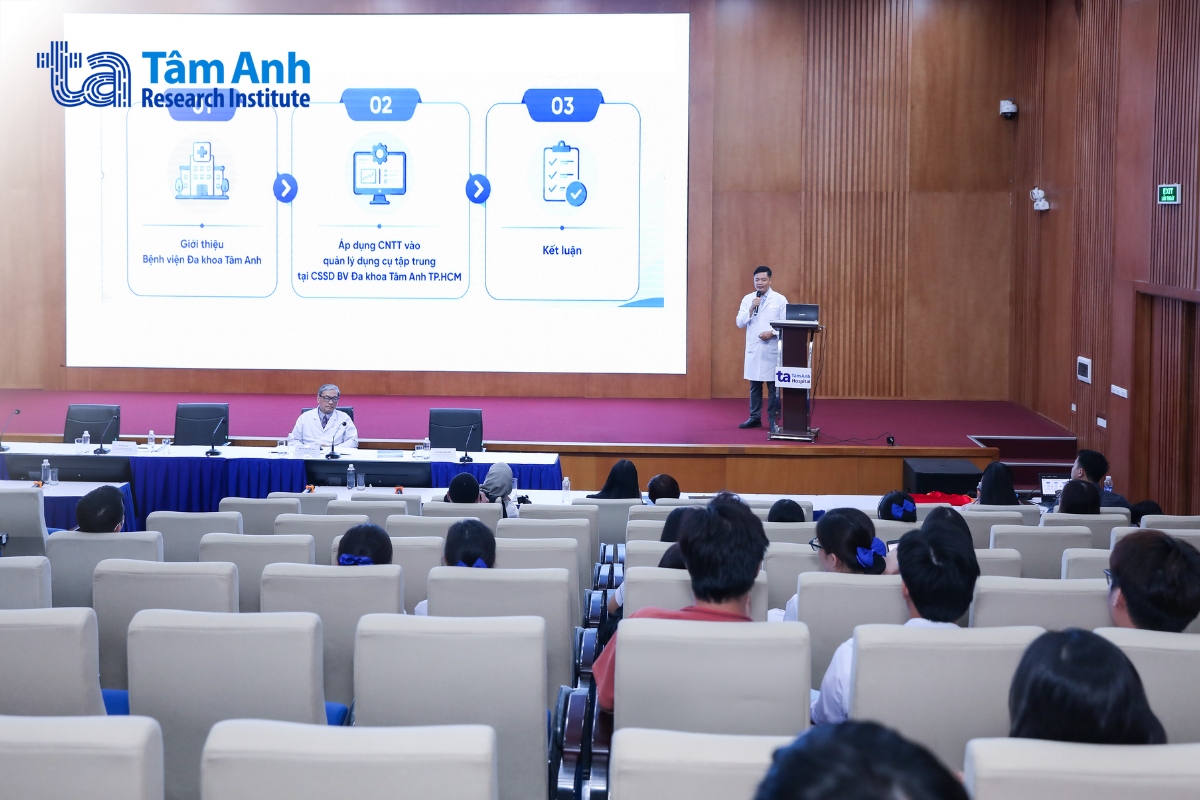
Tong Van Khai, PharmD, presents the CSSD model at Tam Anh General Hospital Ho Chi Minh City.
According to experts, digitalizing CSSD not only minimizes human error and improves data traceability but also contributes significantly to infection control, cost optimization, and the overall quality of healthcare services.
In his closing remarks, Dr. Pham Hung Cuong highly appreciated the in-depth discussions and practical experiences shared by both domestic and international experts throughout the symposium.
Three key themes were explored in depth during the program: standardizing processes to eliminate risks rather than normalize errors; applying information technology to medical instrument management and traceability; and controlling biofilm, a critical factor affecting cleaning quality and sterilization effectiveness.
With the message “Clean Today – Sterile Tomorrow,” the symposium once again underscored the importance of CSSD. More than just a department responsible for instrument processing, CSSD is becoming a vital foundation that enables hospitals to build a safe, integrated, and patient-centered management system.
Tam Anh Research Institute
- Ha Noi:
- 108 Hoang Nhu Tiep, Bo De Ward, Ha Noi
- Hotline: 024 3872 3872 – 024 7106 6858
- TP.HCM:
- 2B Pho Quang Street, Ward Tan Son Hoa, Ho Chi Minh City
- Hotline: 093 180 6858 – 0287 102 6789
- Fanpage: https://www.facebook.com/ViennghiencuuTamAnh.TAMRI
- Website: tamri.vn