
On June 20, a scientific seminar titled “Treatment of Severe Hospital-Acquired Infections Caused by Multidrug-Resistant Gram-Negative Bacteria” convened experts and physicians to discuss optimal strategies for managing multidrug-resistant (MDR) infections.

Held at the Tam Anh Research Institute (TAMRI), the seminar explored advances in infection control and antibiotic selection to improve treatment outcomes and reduce antibiotic resistance. The session was chaired by Phan Thi Xuan, MD, PhD – Head of Intensive Care and Clinical Toxicology and Head of Emergency Department at Tam Anh General Hospital, Ho Chi Minh City. Keynote speakers included Professor David Paterson, MD, PhD, Director of the Center for Clinical Research at the University of Queensland and the Infectious Diseases Department at Royal Brisbane & Women’s Hospital, Australia, and Ngo Minh Quan, MD, from the Diagnostic Center at Tam Anh General Hospital.

Phan Thi Xuan, MD, PhD – Head of Intensive Care and Clinical Toxicology and Head of Emergency Department at Tam Anh General Hospital, Ho Chi Minh City, chairs the scientific seminar
Dr. Quan opened the seminar with a report on “The Status of Gram-Negative Multidrug-Resistant Infections at Tam Anh General Hospital in 2024.” Data revealed that key pathogens include Escherichia coli, Klebsiella pneumoniae, Proteus spp., Enterobacter spp., Pseudomonas aeruginosa, and Acinetobacter baumannii, with Gram-negative bacteria predominant.
Statistics showed Acinetobacter baumannii, a common nosocomial pathogen, exhibited the highest resistance rate (68.1%), followed by Klebsiella pneumoniae (34.5%), Pseudomonas aeruginosa (21.4%), and E. coli (3.8%). Resistance to common antibiotics, particularly Carbapenems and Fluoroquinolones, was alarmingly high. These resistance rates reflect the hospital’s microbiological profile but do not necessarily indicate high in-hospital transmission rates. This data provides a scientific basis for clinicians to select appropriate antibiotics based on real-world conditions.

Ngo Minh Quan, MD, presents the report “Status of Gram-Negative Multidrug-Resistant Infections at Tam Anh General Hospital in 2024” during the scientific seminar
Notably, Tam Anh General Hospital has implemented PCR testing, enabling simultaneous detection of multiple bacterial pathogens and resistance genes within hours, compared to the 48-72 hours required for traditional bacterial cultures.
The hospital’s PCR system identifies common resistance genes such as CTX-M, NDM, OXA-48-like, KPC, IMP, and VIM, allowing physicians to initiate targeted, individualized antibiotic regimens early. Early detection of MDR strains and resistance genes reduces unnecessary antibiotic use and enhances infection control in nosocomial settings.
Dr. Quan concluded that the high prevalence of Gram-negative MDR bacteria, particularly A. baumannii and K. pneumoniae, presents significant treatment challenges. However, the use of PCR testing and regular updates to the hospital’s antibiogram enable clinicians to select effective treatment protocols, improving infection control and patient outcomes.
“Before initiating antibiotic therapy, optimizing microbiological testing is critical. At least one sample, such as aspirate or blood, should be collected to guide subsequent treatment,” emphasized Professor Paterson.
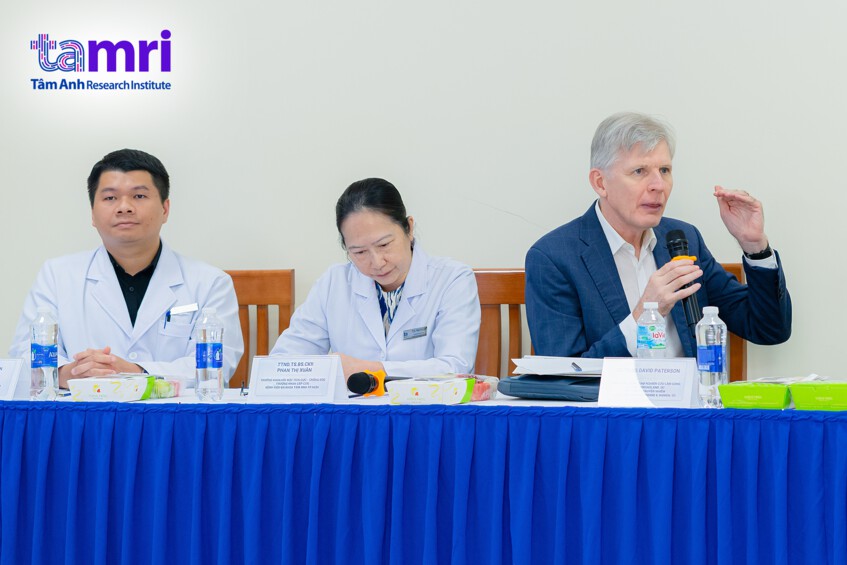
Professor David Paterson, MD, PhD, shares insights at the scientific seminar
Professor Paterson noted that some global healthcare facilities now use molecular tests to identify pathogens within about an hour of sample collection, significantly shortening diagnostic timelines. However, these tests are costly, averaging $250 per test at his hospital. In Vietnam, rapid testing is not yet widely available. Therefore, clinicians must prioritize sample collection before treatment and thoroughly assess risk factors for resistance – such as prior ICU stays, recent hospitalizations, or antibiotic use – to select appropriate initial antibiotics, enhancing treatment outcomes and minimizing resistance.

Physicians participate in the scientific seminar
Professor David Paterson presented findings from a large-scale study involving over 6,000 patients with septic shock treated in intensive care units (ICUs). The study compared two antibiotic administration methods: short-duration infusions versus prolonged infusions lasting at least three hours. Results showed that prolonged infusions were more effective, particularly for critically ill patients, such as those with septic shock in ICU settings, improving survival rates without increasing treatment costs.
Implementing prolonged antibiotic infusions in ICU patients can pose technical challenges, requiring stable, continuous infusion lines. However, with advanced ICU infrastructure and physician-nurse collaboration, this approach is feasible. Not all antibiotics, however, are suitable for continuous or prolonged administration.
Infection control is critical for inpatients, especially those with severe conditions or high risk. A simple yet effective measure is rigorous hand hygiene, strictly enforced between patient interactions to prevent cross-contamination.
“In ICU settings, achieving a survival rate for septic patients comparable to cancer survival rates – around 50% – is considered a significant success,” Professor Paterson noted.
He emphasized that while new-generation antibiotics are costly and less accessible, optimizing current antibiotics through adjusted infusion protocols offers a practical, safe, and cost-effective approach. Prescribing these drugs requires close coordination among treating physicians, ICU specialists, clinical pharmacists, and microbiology units to ensure comprehensive, individualized treatment plans.
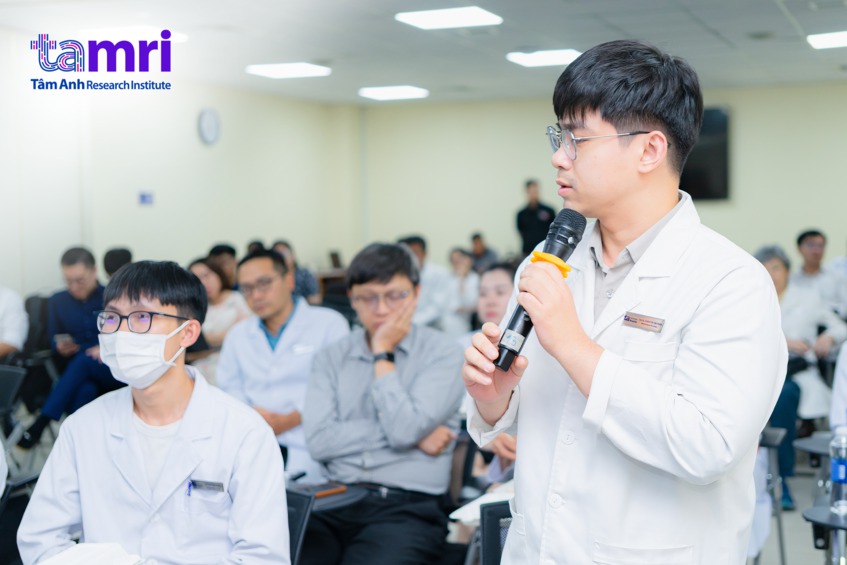
Physicians from Tam Anh General Hospital, Ho Chi Minh City, respond to a clinical case question posed by Professor Paterson
Dr. Phan Thi Xuan, the seminar’s chair, posed a question to Professor Paterson: “In clinical practice, many patients cannot afford brand-name drugs and rely on generic drugs covered by health insurance. How can we identify trustworthy generics to ensure treatment efficacy?”
Professor Paterson responded that some reputable generic manufacturers produce drugs with efficacy comparable to brand-name counterparts. When selecting generics, clinicians should balance cost with the manufacturer’s credibility, avoiding overly cheap options, especially for serious conditions.

Physicians from Tam Anh General Hospital attentively listen to the speakers’ presentations
Dr. Phan Thi Xuan, the seminar’s chair, posed a question to Professor Paterson: “In clinical practice, many patients cannot afford brand-name drugs and rely on generic drugs covered by health insurance. How can we identify trustworthy generics to ensure treatment efficacy?”
Professor Paterson responded that some reputable generic manufacturers produce drugs with efficacy comparable to brand-name counterparts. When selecting generics, clinicians should balance cost with the manufacturer’s credibility, avoiding overly cheap options, especially for serious conditions.

Dr. Phan Thi Xuan expresses gratitude to Professor David Paterson at the scientific seminar
The scientific seminar, held at Tam Anh General Hospital, Ho Chi Minh City, featured lively discussions and real-world clinical case studies among experts and physicians. Marking Professor Paterson’s second visit to the hospital to share expertise on treating severe infections, the event provided valuable insights and practical strategies for optimizing antibiotic use in critically ill patients.
Tam Anh Research Institute
- Ha Noi:
- 108 Hoang Nhu Tiep, Bo De Ward, Ha Noi
- Hotline: 024 3872 3872 – 024 7106 6858
- TP.HCM:
- 2B Pho Quang Street, Ward Tan Son Hoa, Ho Chi Minh City
- Hotline: 093 180 6858 – 0287 102 6789
- Fanpage: https://www.facebook.com/ViennghiencuuTamAnh.TAMRI
- Website: https://tamri.vn
Tam Anh Research Institute
- Ha Noi:
- 108 Hoang Nhu Tiep, Bo De Ward, Ha Noi
- Hotline: 024 3872 3872 – 024 7106 6858
- TP.HCM:
- 2B Pho Quang Street, Ward Tan Son Hoa, Ho Chi Minh City
- Hotline: 093 180 6858 – 0287 102 6789
- Fanpage: https://www.facebook.com/ViennghiencuuTamAnh.TAMRI
- Website: tamri.vn