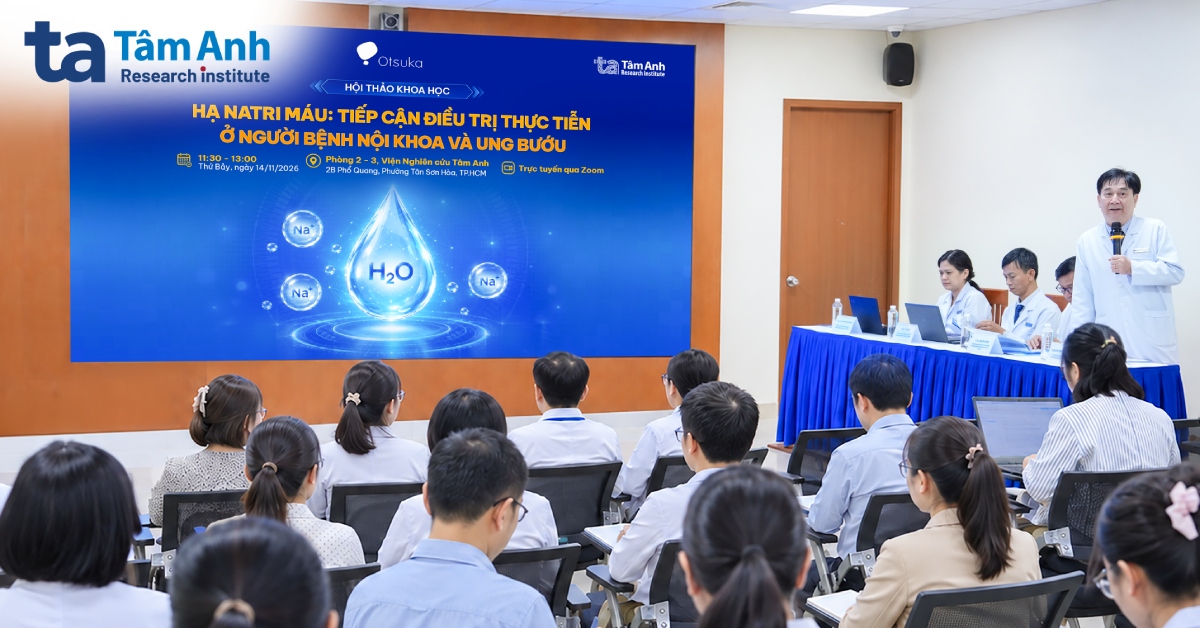
The scientific symposium “Hyponatremia: Practical Treatment Approaches in Internal Medicine and Oncology” was held at noon on November 14. Photo: Tam Anh General Hospital.
Improving care for patients with hyponatremia in internal medicine and oncology
Hyponatremia is one of the most common electrolyte disorders among hospitalized patients, particularly those with internal medicine conditions and cancer. It can significantly affect patients’ quality of life, increase treatment costs and the risk of hospital readmission, and even increase mortality if not promptly diagnosed and appropriately managed.
These issues were discussed at the scientific symposium “Hyponatremia: Practical approaches to management in internal medicine and oncology patients,” held at noon on November 14 at Tam Anh General Hospital in Ho Chi Minh City (HCMC).
According to Pham Xuan Dung, MD, PhD, Director of the Oncology Center at Tam Anh General Hospital in HCMC, hyponatremia is relatively common among hospitalized patients, including those with lung, head and neck, and pancreatic cancers. More than 40% of patients with non-small cell lung cancer (NSCLC) may develop this condition. Potential causes include paraneoplastic syndromes, cancer treatments that stimulate antidiuretic hormone (ADH) secretion, and certain medications that affect renal tubular function or ADH levels.

Dr. Tran Nguyen Quynh Tram presents practical approaches to treating hyponatremia in clinical practice from an endocrinology perspective.
Drawing on specific clinical cases, Tran Nguyen Quynh Tram, MD, MSc, Deputy Head of the Department of Endocrinology and Diabetes at Tam Anh General Hospital Group in HCMC, noted that studies have reported hyponatremia in approximately 15% to 42% of hospitalized patients. The condition is associated with a 2.6-fold increase in the risk of mortality, with in-hospital mortality increasing even among patients with mild hyponatremia. Diagnosis is based on several parameters, including serum osmolality, urine osmolality, extracellular fluid volume, and urinary sodium levels.
Management and treatment vary depending on the severity of hyponatremia and the patient’s specific clinical course. However, severe hyponatremia requires urgent treatment, regardless of its classification or underlying cause.
The syndrome of inappropriate antidiuresis (SIAD) is the most common cause of hyponatremia. It results from inappropriate ADH secretion by the posterior pituitary gland or from sources outside the pituitary gland. Clinical experience has shown that there is no single “best” treatment suitable for all patients with SIAD. Therefore, careful consideration and thorough assessment are essential when determining the appropriate treatment approach.

Dr. Tran Hai Binh highlights the role and impact of sodium in cancer patients.
According to Tran Hai Binh, MD, PhD, Deputy Head of the Oncology Department at Tam Anh General Hospital in Hanoi, sodium plays a direct regulatory role in cancer, may be involved in cellular metabolism, and can promote immune responses. Low serum sodium levels and hyponatremia may inhibit apoptosis (programmed cell death), increase tumor invasion and metastasis, and promote resistance to immunotherapy and chemotherapy in cancer patients.
Hyponatremia is highly prevalent among cancer patients. A retrospective study involving 3,358 cancer patients in the United States found that as many as 47% had hyponatremia.
Hyponatremia prolongs hospital stays, increases healthcare costs and mortality rates, and reduces responses to targeted therapy. Early detection, careful monitoring, and appropriate treatment of hyponatremia not only help improve symptoms but can also directly improve the prognosis of cancer patients.

Dr. Le Tan Dat provides further insights into hyponatremia in cancer patients.
Le Tan Dat, MD, PhD, Deputy Director of the Oncology Center at Tam Anh General Hospital in HCMC, added that hyponatremia affects approximately 50% of cancer patients and directly impacts their prognosis and treatment. Therefore, attention should be paid to patients’ clinical symptoms from the outset. SIAD in cancer patients may be associated with increased ADH secretion due to various causes, including pneumonia in patients with small cell lung cancer, head and neck cancer, or certain cancers at the metastatic stage, particularly those with brain metastases. Cancer patients with severe hyponatremia need to have their hyponatremia treated before resuming their cancer treatment regimens.
Lam Van Hoang, MD, PhD, Head of the Department of Endocrinology and Diabetes at Tam Anh General Hospital Group in HCMC, noted that managing electrolyte disorders in clinical practice, including hyponatremia, is challenging. Electrolyte imbalances in patients with internal medicine conditions and cancer are a major concern influenced by multiple factors. Therefore, recognizing these disorders, assessing patients, and staying up to date with treatment strategies for hyponatremia in internal medicine and oncology patients are important tasks that contribute to improving the quality of patient care.
Tam Anh Research Institute
- Ha Noi:
- 108 Hoang Nhu Tiep, Bo De Ward, Ha Noi
- Hotline: 024 3872 3872 – 024 7106 6858
- TP.HCM:
- 2B Pho Quang Street, Ward Tan Son Hoa, Ho Chi Minh City
- Hotline: 093 180 6858 – 0287 102 6789
- Fanpage: https://www.facebook.com/ViennghiencuuTamAnh.TAMRI
- Website: tamri.vn