Managing thromboembolism in patients with cancer involves more than simply selecting an anticoagulant. It requires a multidisciplinary approach to comprehensively assess patient condition, stratify risks, and provide close monitoring in order to optimize treatment outcomes.
This was one of the key messages shared by Assoc. Prof. Pham Nguyen Vinh, MD, PhD, Vice President of the Vietnam National Heart Association and Director of the Cardiovascular Center at Tam Anh General Hospital Group in Ho Chi Minh City (HCMC), together with other experts at the scientific symposium entitled “Advances in the management of thrombosis in cancer patients”, held on June 16, 2026, at the Tam Anh Research Institute, part of the Tam Anh General Hospital Group.

Assoc. Prof. Pham Nguyen Vinh, MD, PhD (center); Dr. Pham Xuan Dung, MD, PhD, Director of the Oncology Center at Tam Anh General Hospital HCMC (far right); together with experts, physicians, and sponsor representatives at the scientific symposium “Advances in the management of thrombosis in cancer patients”
Thromboembolic disease represents a major health burden affecting both the arterial and venous systems. Among these conditions, venous thromboembolism (VTE), including deep vein thrombosis (DVT) and pulmonary embolism (PE), is a common and serious medical condition that affects millions of people worldwide.
Up to 20% of cancer patients develop deep vein thrombosis or pulmonary embolism, making VTE the second leading cause of death among individuals with cancer. Pancreatic, lung, gastrointestinal, kidney, breast, and prostate cancers are among the malignancies associated with the highest risk of thrombus formation.
Updated recommendations for thromboembolism management in cancer patients
In her presentation entitled “Updates in Thromboembolism Management Strategies for Cancer Patients – Are We Missing Anything?”, Dr. Tran Vu Minh Thu, Head of Cardiology Department 2 at the Cardiovascular Center of Tam Anh General Hospital HCMC, explained that thromboembolism in cancer patients may result from the biological mechanisms associated with cancer itself or from cancer treatments such as chemotherapy, corticosteroid therapy, surgery, or prolonged catheter use. Cancer patients often develop a hypercoagulable state due to the combined effects of blood stasis, vascular endothelial injury, and increased coagulation activity.
Managing thromboembolism in cancer patients remains a major challenge because clinicians must balance the effectiveness of anticoagulant therapy in treating and preventing thrombus formation against the risk of bleeding associated with both the disease and cancer treatments. This requires individualized treatment strategies and close collaboration among multiple specialties.

Dr. Tran Vu Minh Thu emphasizes the importance of tailoring treatment strategies according to each patient’s clinical condition and risk of recurrent thromboembolism.
Vietnam National Heart Association recommendations highlight a shift in thromboembolism management from reliance on low-molecular-weight heparin (LMWH) alone toward more individualized treatment approaches that increasingly incorporate non-vitamin K antagonist oral anticoagulants (NOACs). Treatment should continue for at least six months or until the cancer is cured.
Dr. Thu further noted that decisions regarding treatment duration and anticoagulant selection should carefully balance the risk of recurrent thromboembolism, bleeding risk, and the characteristics of each cancer type. In addition, risk stratification is essential for determining appropriate primary thromboprophylaxis.
Tailoring treatment strategies across different stages of care
To further illustrate the topic “Optimizing Anticoagulant Therapy for the Treatment and Prevention of Recurrent Venous Thromboembolism in Cancer Patients – A Clinical Case Study”, Dr. Tran Huu Danh from Cardiology Department 2 at the Cardiovascular Center of Tam Anh General Hospital HCMC, presented the case of a 55-year-old man with pancreatic cancer that had metastasized to the liver and adrenal glands. One week before hospital admission, the patient experienced painful numbness in his right calf that worsened with walking and improved with rest. His right leg was also noticeably more swollen than the left. Assuming the symptoms were caused by varicose veins, he self-medicated, but his condition did not improve. Several days later, the pain became more severe and was accompanied by persistent shortness of breath. After presenting to Tam Anh General Hospital HCMC, he was diagnosed with complete thrombosis of the right great saphenous vein and pulmonary embolism.
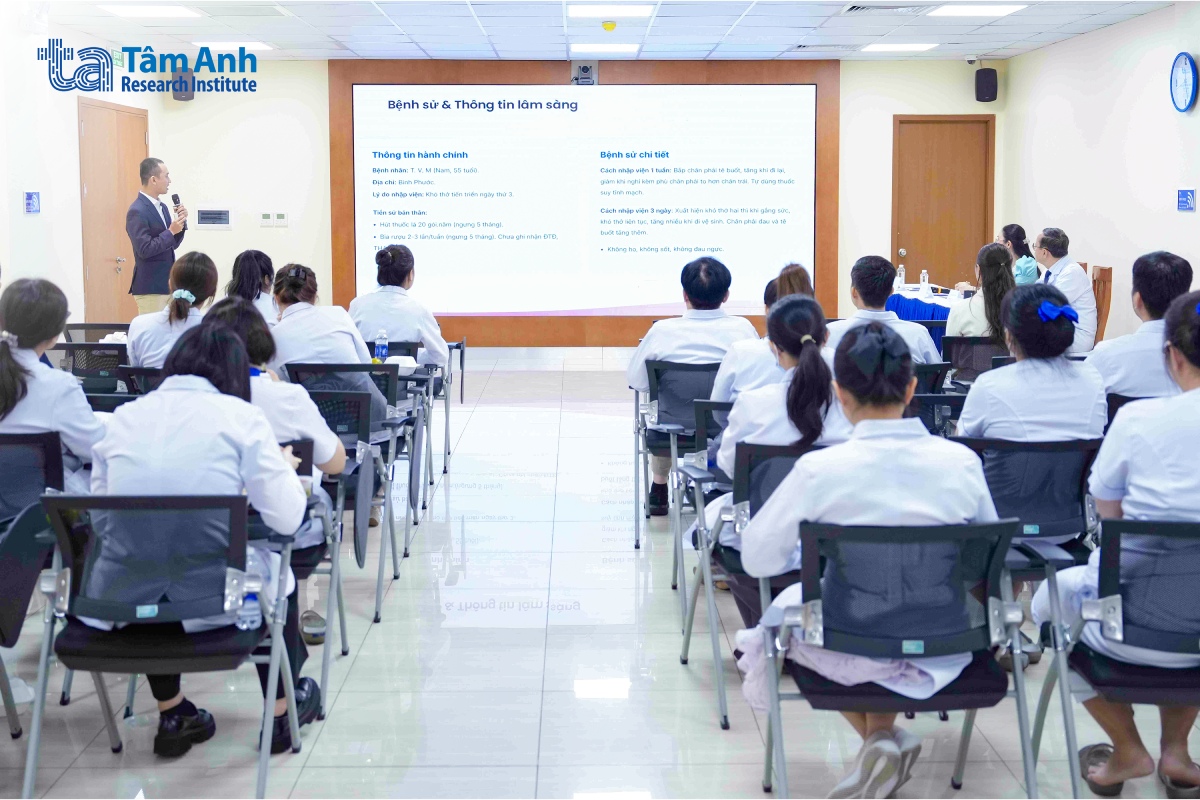
Dr. Tran Huu Danh presents a clinical case of pulmonary embolism and venous thrombosis in a patient with metastatic pancreatic cancer successfully treated at Tam Anh General Hospital HCMC.
Pancreatic cancer is recognized as one of the solid malignancies with the highest risk of triggering thrombosis and venous thromboembolism. The patient was classified as having a high 30-day mortality risk. Therefore, during the acute phase (the first five days), physicians prescribed subcutaneous anticoagulant injections every 12 hours to achieve rapid and safe anticoagulation. The patient was subsequently transitioned to daily oral anticoagulant therapy for long-term management. Two months later, although he remained compliant with anticoagulant treatment, he discontinued chemotherapy and instead used traditional herbal medicine at home. As a result, the pancreatic cancer progressed, metastasizing to both kidneys, causing severe thrombocytopenia while coagulation activity remained elevated, placing him at continued risk of thrombus progression if anticoagulation were discontinued.
Clinicians immediately suspended anticoagulant therapy to control the risk of acute bleeding. After three days, when the patient’s platelet count returned to a safe level, anticoagulation was resumed to prevent recurrent thrombosis.

Dr. Pham Xuan Dung, MD, PhD, exchanges professional insights with physicians and healthcare professionals during the scientific symposium.
Experts emphasized that as the number of cancer patients continues to increase and life expectancy improves thanks to advances in diagnosis and treatment, early identification and effective management of thromboembolic risk have become increasingly important.
Through its annual scientific symposia, the Tam Anh Research Institute continues to provide a platform for connecting experts from both within and outside the healthcare system, fostering academic exchange, updating the latest medical advances, and facilitating the application of international recommendations in clinical practice, ultimately delivering meaningful benefits to patients.
Tam Anh Research Institute
- Ha Noi:
- 108 Hoang Nhu Tiep, Bo De Ward, Ha Noi
- Hotline: 024 3872 3872 – 024 7106 6858
- TP.HCM:
- 2B Pho Quang Street, Ward Tan Son Hoa, Ho Chi Minh City
- Hotline: 093 180 6858 – 0287 102 6789
- Fanpage: https://www.facebook.com/ViennghiencuuTamAnh.TAMRI
- Website: tamri.vn