On June 15, 2026, Tam Anh Research Institute, in collaboration with Tam Anh General Hospital Group, officially commenced the professional technical training course titled “Fundamentals of Laparoscopic Surgery”. Limited to a small cohort of 5 to 10 participants per course and emphasizing a direct mentorship-based approach, the program focuses on intensive hands-on practice utilizing a 4K-resolution 3D laparoscopic system, attracting numerous physicians from various medical institutions seeking to master minimally invasive surgical techniques.
According to BMJ Oncology (2023), the global incidence of early-onset gastrointestinal cancers in individuals under 50 increased by 79.1% between 1990 and 2019. Gastrointestinal cancers and other severe digestive disorders often present with vague initial symptoms or mimic benign conditions, leading to delayed medical attention and treatment.
This reality poses a significant clinical challenge, necessitating that healthcare facilities master advanced, minimally invasive surgical techniques to deliver more effective treatment outcomes.
In this context, laparoscopic surgery continues to solidify its pivotal role in modern surgery. Utilizing micro-incisions of only 5 to 10 mm, this modality provides surgeons with enhanced access to the operative field and greater procedural precision. Concurrently, it offers patients reduced postoperative pain, minimal blood loss, a lower risk of surgical site infections, and accelerated recovery. Beyond improving therapeutic efficacy, laparoscopy significantly contributes to preserving the patient’s quality of life and cosmetic outcomes.
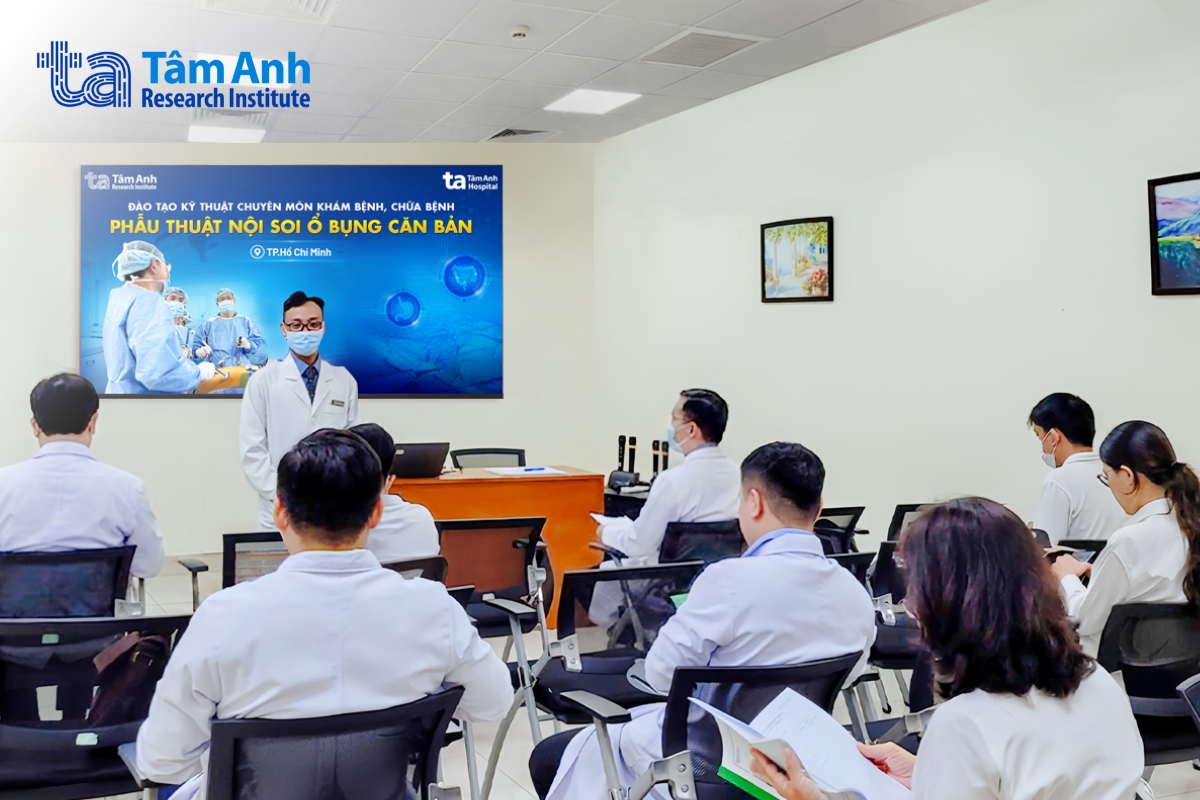
The “Fundamentals of Laparoscopic Surgery” course is structurally designed to equip participants with the foundational knowledge and essential practical skills required to meet the evolving demands of modern medicine and clinical realities.
Clinically oriented intensive hands-on training
A core defining feature of the course is its orientation toward specialized, clinically relevant hands-on training. Conducted on a small scale of 5 to 10 trainees per cohort, the program ensures individualized guidance, optimizing knowledge retention and skill acquisition.

The instructional faculty comprises leading experts and highly experienced physicians from Tam Anh General Hospital Group Ho Chi Minh City, who guide participants in mastering fundamental principles and techniques using advanced, specialized equipment.
The curriculum encompasses 330 training hours over a three-month period, closely integrating theoretical foundations with practical application in modern operating rooms. Trainees are instructed on the operational principles of next-generation endoscopic systems, such as the Olympus EVIS X1 CV-1500 and Fujifilm 7000 – advanced endoscopy systems utilized for gastroscopy, colonoscopy, and the early detection of precancerous and malignant gastrointestinal lesions.
Furthermore, Tam Anh integrates the 3D/4K laparoscopic system with Indocyanine Green (ICG) fluorescence technology and the new-generation Da Vinci Xi robotic system for treating complex digestive conditions, ranging from gallstones to gastric, colorectal, and hepato-pancreato-biliary cancers. These technologies enhance the visualization of anatomical structures, allow for precise evaluation of blood vessels and biliary tracts, improve surgical accuracy, minimize complications, and facilitate faster patient recovery.
Concurrently, participants undergo rigorous training in critical surgical skills, including clamping, coagulation, dissection, suturing, hemostasis, and achieving adequate exposure of the operative field, enabling precise intraoperative assessment of pathologies.
The course is taught by a team of leading experts in Gastroenterology, Hepatobiliary-Pancreatic Surgery, and Anesthesiology & Critical Care, including : Dr. Do Minh Hung, PhD; Dr. Pham Huu Tung, PhD; Dr. Pham Cong Khanh, PhD; Dr. Nguyen Quoc Thai, and Dr. Luu Kinh Khuong. The presence of these highly experienced experts not only helps trainees standardize their techniques but also equips them with a systematic, safe, and up-to-date clinical decision-making mindset.
Practical training on advanced surgical systems
In addition to its high-caliber faculty, the course is distinguished by its practical environment featuring an ecosystem of modern surgical equipment. Participants gain direct hands-on experience with the advanced 3D/4K ICG Rubina Karl Storz laparoscopic system (Germany).
This system simulates human binocular vision using three-dimensional, dual-independent-channel imaging combined with ICG fluorescence overlay technology, delivering sharp 4K resolution and true-to-life color reproduction. Consequently, surgeons can distinctly visualize anatomical structures and identify small tissue structures and blood vessels, which is particularly beneficial in narrow or complex operative fields. This capability enhances procedural precision while minimizing the risk of postoperative complications such as nerve damage, infections, intestinal adhesions, or incisional hernias.
Early exposure to cutting-edge technologies during training is a significant advantage, effectively bridging the gap between medical education and clinical practice at the physicians’ respective institutions.

The 3D/4K ICG Rubina Karl Storz laparoscopic system provides sharp, highly magnified imaging, helping to protect small nerves in complex areas during procedures and reducing postoperative complications such as infections, incisional hernias, and intestinal adhesions.
Standardizing surgical competency and elevating therapeutic capacity
Upon program completion, participants are awarded the Certificate of Professional Medical Technical Training in “Fundamentals of Laparoscopic Surgery”. This credential serves not only as a testament to rigorous academic training but also as a vital stepping stone for physicians to confidently apply these techniques in clinical practice, safely managing cases such as appendectomies, cholecystectomies, and colorectal interventions.
This training course reaffirms Tam Anh Research Institute’s strategic commitment to developing high-quality continuing medical education programs. By standardizing the professional competencies of healthcare personnel and disseminating advanced therapeutic modalities to various medical facilities, the initiative ultimately expands patient access to safer, modern, and high-quality healthcare services nationwide.
Tam Anh Research Institute
- Ha Noi:
- 108 Hoang Nhu Tiep, Bo De Ward, Ha Noi
- Hotline: 024 3872 3872 – 024 7106 6858
- TP.HCM:
- 2B Pho Quang Street, Ward Tan Son Hoa, Ho Chi Minh City
- Hotline: 093 180 6858 – 0287 102 6789
- Fanpage: https://www.facebook.com/ViennghiencuuTamAnh.TAMRI
- Website: tamri.vn