
Overweight or obesity not only contributes to various health problems but also significantly impacts cognitive disorders (dementia). Proper weight control and effective weight loss treatments can help mitigate the risk of dementia.

The Impact of Obesity on Cognitive Decline
At the scientific seminar on “Multimodal Treatment of Obesity” held on the afternoon of July 1 at Tam Anh Research Institute (TAMRI), doctors from Tam Anh General Hospital in Ho Chi Minh City highlighted the current state of obesity, as well as the association between obesity and dementia.
Dr. Le Van Tuan, MD, PhD, Director of the Neuroscience Center at Tam Anh General Hospital, explained that dementia arises from various risk factors. The condition manifests in different severities, affecting memory, language, motor functions, among others.

Dr. Le Van Tuan elucidating the mechanisms linking obesity to dementia.
When addressing whether and how obesity contributes to cognitive decline, Dr. Le Van Tuan explained that obese individuals are at higher risk of vascular complications, which can lead to stroke and subsequent cognitive impairment. Obesity also increases the likelihood of developing diabetes and its vascular complications. Additionally, obesity is often accompanied by hypertension, one of the major causes of stroke, adversely affecting neurological and cognitive functions.
Regarding the concept of type 3 diabetes, Dr. Tuan referred to insulin resistance in the brain, which results in a cascade of metabolic, immunological, and inflammatory disorders. Patients with dementia (such as Alzheimer’s disease) and diabetes share notable similarities, including insulin resistance.
Obese individuals tend to accumulate adipose tissue, especially in the abdominal region. This tissue not only stores energy but also secretes substances that disrupt endocrine and neurological functions when present in excess. In cases of neurological damage, hormones like leptin (which regulate satiety) may become dysregulated, causing leptin resistance. This not only contributes to further obesity but also affects higher-order neurological functions.
Overweight and obese individuals often experience gut microbiota imbalances, which can disrupt the gut-brain axis, influencing various brain functions, and contributing to neurodegeneration. Studies show that increases in body mass index (BMI) correlate with reductions in gray matter volume and cortical thickness, negatively impacting cognitive abilities.
Obesity also induces chronic inflammation in the body, including the brain, with initial effects observed in the hypothalamus and other brain regions. This is considered one of the mechanisms contributing to Alzheimer’s disease.
GLP-1 and the Preservation of Neuronal Function
Dr. Hoang Thi Hong Linh, from the Weight Control Center at Tam Anh General Hospital, noted that obesity is linked to over 200 complications affecting multiple organs, including the nervous system.
Several studies on GLP-1 receptor agonists (GLP-1 RAs) indicate that these drugs possess anti-inflammatory and antioxidant properties, helping reduce inflammation and oxidative stress in the brain.
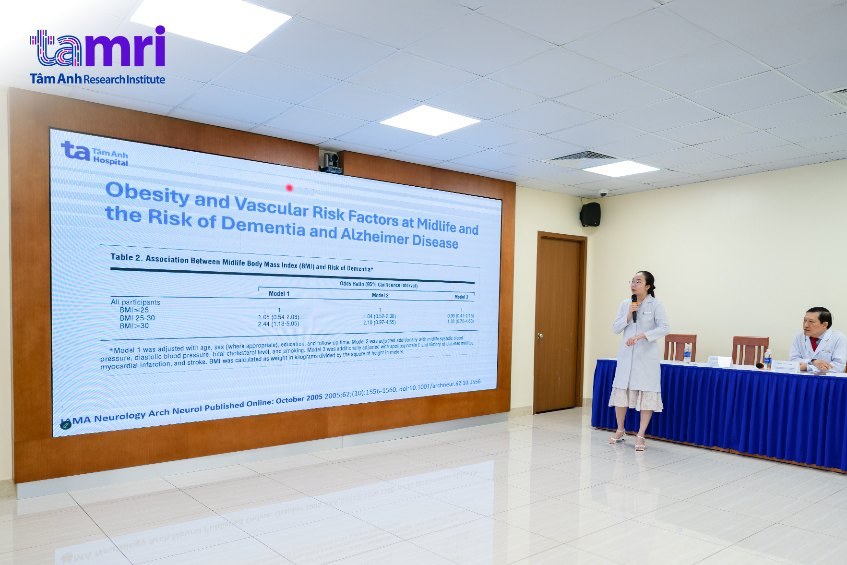
Dr. Hoang Thi Hong Linh explaining the role of GLP-1 in reducing dementia risk.
Insulin resistance in key brain areas is associated with cognitive impairment. GLP-1 RAs have been proven to cross the blood-brain barrier and enhance insulin signaling, which helps preserve neuronal function.
GLP-1 RAs also support neuronal survival and enhance synaptic plasticity, positively influencing the pathophysiology of Alzheimer’s disease and preserving energy metabolism and cognitive function, especially in the early stages of the disease.
Studies indicate that in patients with type 2 diabetes, or obesity, GLP-1 RAs are associated with a reduced risk of dementia and offer neuroprotective benefits. “Controlled weight loss using GLP-1 provides dual benefits for metabolic health and cognitive function, without the harmful effects associated with unintentional weight loss in elderly individuals,” Dr. Linh noted.
At the seminar, Dr. Lam Van Hoang, MD, PhD, Director of the Weight Control Center at Tam Anh General Hospital, highlighted that obesity impacts multiple health domains, including cognitive function. Dementia is not confined to the elderly; younger individuals with obesity are also susceptible to cognitive decline, which may present as reduced attention span and slower reading comprehension compared to their healthy peers. Ongoing research on GLP-1, obesity, and dementia holds potential for the development of rapid diagnostic tools to detect cognitive impairment in obese patients.
Tam Anh Research Institute
- Ha Noi:
- 108 Hoang Nhu Tiep, Bo De Ward, Ha Noi
- Hotline: 024 3872 3872 – 024 7106 6858
- TP.HCM:
- 2B Pho Quang Street, Ward Tan Son Hoa, Ho Chi Minh City
- Hotline: 093 180 6858 – 0287 102 6789
- Fanpage: https://www.facebook.com/ViennghiencuuTamAnh.TAMRI
- Website: tamri.vn