The treatment approach for Systemic Lupus Erythematosus (SLE) is shifting from symptom control to comprehensive disease management, combining autoantibody testing for early diagnosis, treat-to-target strategies, and targeted biologic therapies to reduce organ damage and minimize corticosteroid dependence.
These insights were shared by experts at the scientific seminar “Updates in the diagnosis and treatment of Systemic Lupus Erythematosus in clinical practice,” held at Tam Anh General Hospital in Ho Chi Minh City (HCMC) at noon on August 22.

Assoc. Prof. Hoang Thi Lam, MD, PhD, Head of the Clinical Immunology Department at Tam Anh General Hospital in HCMC, and President of the Vietnam Young Physicians Association – Allergy and Immunology Branch (right), provided updates on the diagnosis and treatment of systemic lupus erythematosus.
Recognizing lupus through subtle, easily overlooked signs
According to Dr. Trinh Hoang Kim Tu, MD, PhD, Lead of the Allergy and Immunology Group at the Center for Molecular Biomedicine, University Medical Center HCMC, and Secretary-General of the Vietnam Young Physicians Association – Allergy and Immunology Branch, lupus can develop insidiously, with autoantibodies appearing before systemic clinical manifestations develop.
Most patients initially present with signs such as a malar rash, discoid rash, painless oral ulcers, non-scarring hair loss, or Raynaud’s phenomenon, in which the fingertips change color in response to cold. Patients may also experience joint pain, persistent fatigue, anemia, or reduced blood cell counts.
Because lupus has diverse manifestations that can be mistaken for many other conditions, it may easily be overlooked if each symptom is assessed in isolation. Therefore, when patients present with skin lesions, joint pain, persistent anemia, or renal abnormalities, physicians should consider the overall clinical picture and medical history to avoid missing signs suggestive of early-stage lupus.

Dr. Trinh Hoang Kim Tu shared information on signs that can help with the early recognition of SLE.
Based on suspicious clinical signs, physicians may order immunological tests to support the diagnosis. According to the 2019 EULAR/ACR classification criteria, a positive antinuclear antibody (ANA) test at a titer of ≥1:80 is an entry criterion for further evaluation of SLE. Therefore, ANA testing is usually performed first, followed by testing for specific autoantibodies when necessary, helping avoid ordering too many tests at the outset.
Among these tests, anti-dsDNA antibodies and complement C3 and C4 levels provide additional information about disease activity and the risk of renal involvement. Anti-Ro and Anti-La antibodies are particularly important in pregnant women, helping physicians assess the risk of neonatal lupus in the infant.
Autoantibody testing not only supports the diagnosis of lupus but also provides important information for physicians to assess disease severity, identify the risk of organ damage, and determine appropriate monitoring and treatment strategies.
Treatment beyond controlling acute flares
A notable change in current lupus treatment is the shift from symptom control to a treat-to-target approach. According to Nguyen Phuc Tan, MD, PhD, Department of Clinical Immunology, Tam Anh General Hospital in HCMC, the goal is to achieve remission or low disease activity, thereby limiting cumulative organ damage over time.
This is a considerable challenge because lupus may be highly active at times, stable at others, and then flare again. If the disease is not adequately controlled, approximately 50% of patients may develop irreversible organ damage within 10 years.

Dr. Nguyen Phuc Tan shared insights on targeted treatment strategies for lupus.
Corticosteroids remain important, particularly for controlling disease flares. However, prolonged use can expose patients to various adverse effects, including an increased risk of infections, diabetes, metabolic disorders, and other complications. Therefore, once the disease is controlled, corticosteroid doses should be reduced and the duration of use limited, while other appropriate treatment options should be considered.
Modern treatment aims to gradually reduce corticosteroid use, with a target maintenance dose of less than 5 mg per day or discontinuation when appropriate. Hydroxychloroquine remains a cornerstone therapy for most patients in the absence of contraindications, together with regular retinal monitoring.
Biologic therapies open new avenues for disease control
One of the notable changes in lupus treatment is the emergence of biologic therapies that directly target the immune mechanisms underlying the disease. Among these, type I interferon is considered an important link in the disease mechanism. When this pathway is excessively activated, the immune system can sustain inflammation and cause damage to multiple organs.

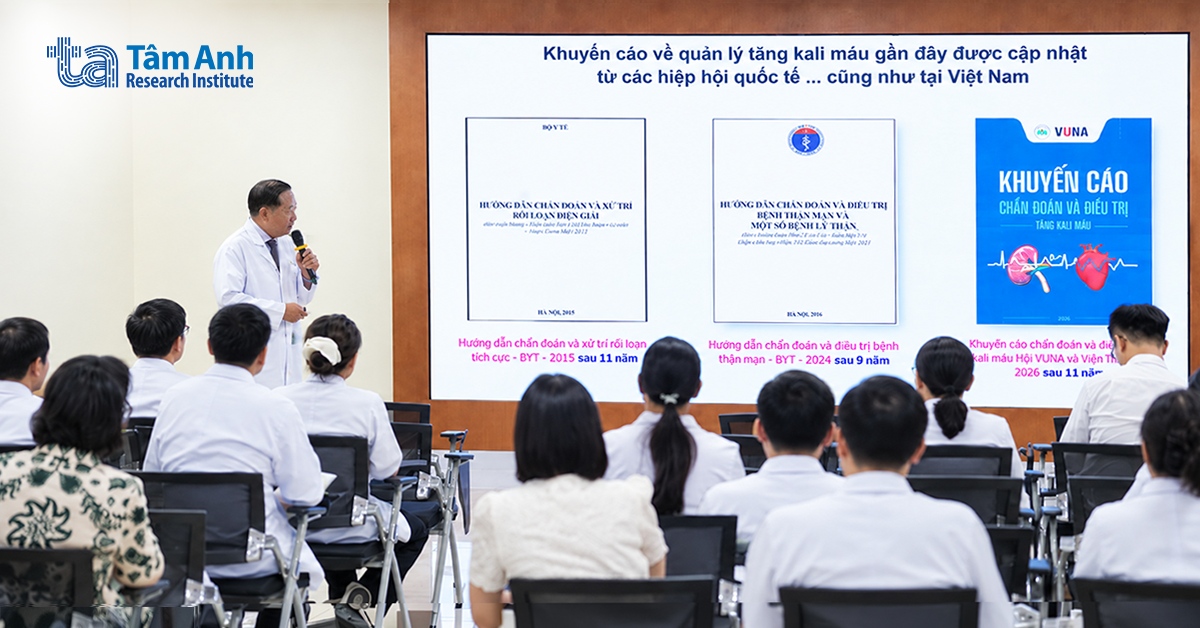
A large number of physicians and healthcare professionals from Tam Anh General Hospital attended the scientific seminar.
Anifrolumab is a monoclonal antibody that targets the type I interferon receptor (IFNAR1), helping block this signal from being transmitted into cells. The TULIP-1 and TULIP-2 studies showed that the drug can help reduce disease activity, improve treatment response, and support corticosteroid dose reduction in appropriate patients.
According to the physicians, a notable advantage of biologic therapies is their ability to target a specific component of the disease mechanism rather than simply addressing the manifestations that have already appeared. However, biologics do not completely replace existing treatment approaches and should be selected based on disease activity, affected organs, and each patient’s response.
Because interferon also plays a role in antiviral defense, patients should be assessed for infection risk before and during treatment. Some patients may have an increased risk of herpes zoster, so physicians may consider appropriate screening and vaccination as appropriate.