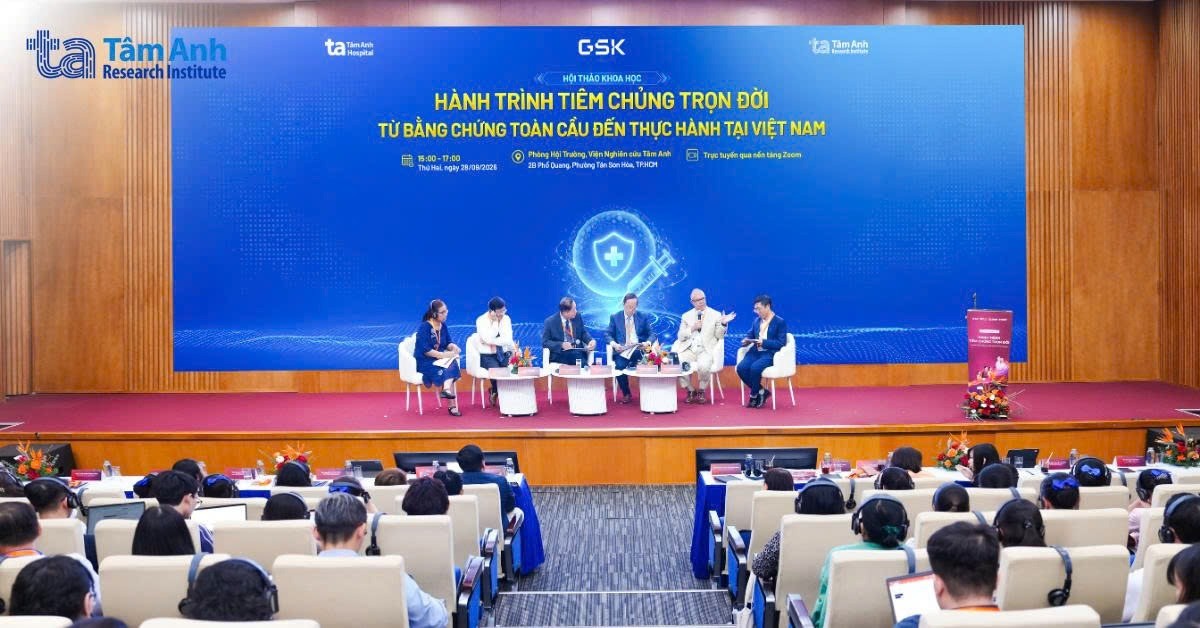
Professor Mark Sklansky, one of the world’s leading experts in fetal and pediatric cardiology, conducted a live demonstration of fetal echocardiography techniques at the “First Intensive Training Course on Fetal Echocardiography”, held on March 9, 2025, at the Tam Anh Research Institute (TAMRI).
Professor Mark Sklansky currently serves as Director of the Fetal Cardiology Program, Medical Director of the Pediatric Heart Center, and Co-Director of the Congenital and Pediatric Heart Program at UCLA Mattel Children’s Hospital, under the David Geffen School of Medicine at UCLA, USA.
Professor Sklansky is one of the world’s foremost experts in fetal and pediatric cardiology. His primary focus lies in the detection, assessment, and prenatal management of congenital heart disease. He has published nearly 120 papers across areas such as fetal cardiology, pediatric cardiology, and 3D-4D fetal echocardiography. Among his most notable works is the widely cited 2016 paper titled “Fetal Cardiac Screening: What are we (and our guidelines) doing wrong?”
What sets Professor Sklansky apart is his ability to help learners recognize the critical importance of hands-on skills in fetal echocardiography and how to obtain the most optimal fetal heart images, enhancing the effectiveness of screening for congenital heart defects.
Professor Mark Sklansky, a world-renowned expert in fetal cardiology and congenital heart disease, shared his professional expertise with hundreds of specialists and physicians at the conference.
At the “First Intensive Training Course on Fetal Echocardiography” on March 9 at the Tam Anh Research Institute (TAMRI), Tam Anh HCMC General Hospital, Professor Mark Sklansky delivered a series of lectures covering: Fetal Cardiac Imaging – What Are We (and Our Guidelines) Doing Wrong?, Common Pitfalls in Fetal Heart Imaging, Aortic Coarctation, Total Anomalous Pulmonary Venous Return, Fetal Arrhythmias, Tetralogy of Fallot, Fetal Cardiac Function Assessment, Stratification of Congenital Heart Defects, and Heterotaxy Syndrome.
The course attracted nearly 200 specialists and physicians who attended in person at the TAMRI auditorium, while over 300 others participated online.
In addition, several presentations at the conference offered high practical value and highlighted recent advances in diagnostic and screening techniques, contributing significantly to improved outcomes in the treatment of congenital heart disease, including:
- “Updates on Fetal Cardiac Screening and Advanced Fetal Echocardiography Guidelines” by Dr. Ha To Nguyen, MSc, Vice President of the HCMC Society of Maternal and Fetal Medicine (HSMFM), Vice President of the Vietnam Society of Ultrasound in Medicine (VSUM), and Director of the Fetal Medicine Center at Tam Anh HCMC General Hospital.
- “Transposition and Corrected Transposition of the Great Arteries” by Assoc. Prof. Dr. Lê Minh Khôi, Vice President of the HCMC Pediatric Cardiology and Congenital Heart Disease Association and Head of the Department of Science and Training at the HCMC University Medical Center.
- Two engaging case-based sessions on practical aspects of fetal cardiology delivered by Dr. Le Kim Tuyen, PhD, Vice President of the HCMC Pediatric Cardiology and Congenital Heart Disease Association, congenital heart disease specialist at Tam Đức Hospital, and lecturer at Pham Ngoc Thach University of Medicine.
- Dr. Do Thi Cam Giang, Level II Specialist in Cardiology at Children’s Hospital 1.
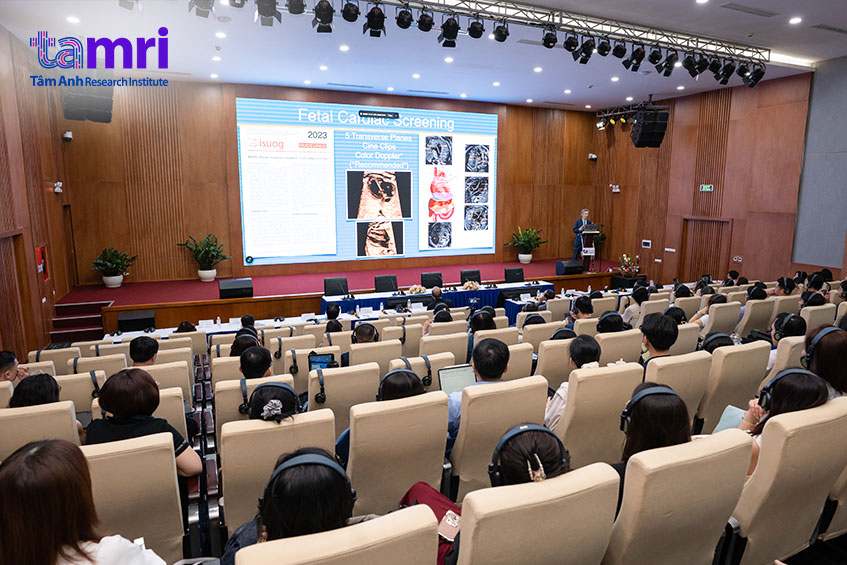
Hundreds of specialists and physicians participated in the “First Intensive Training Course on Fetal Echocardiography”, held on March 9 at the Tam Anh Research Institute (TAMRI).
Professor Sklansky shared that congenital heart disease is the most common type of birth defect, and early diagnosis, especially before birth, can make a significant difference in the prognosis for affected infants. However, in reality, most congenital heart defects remain undetected during pregnancy. The primary reason, both in Vietnam and globally, is that during fetal echocardiography, the fetus is often not in an ideal position for optimal heart visualization. Unfavorable angles make accurate assessment considerably more challenging.
Guidelines are continually being updated, placing higher demands on the screening process for congenital heart defects. For example, experts now recommend including the three-vessel view in standard fetal heart screening protocols. Previously, this view was not considered mandatory, but it is now recognized as a critical perspective, one that is worth training time.
In addition, current international medical guidelines do not yet mandate the use of color Doppler in low-risk pregnancies. “However, I believe this technique should be more widely adopted, even in low-risk cases. Although it requires additional training time, I consider this investment essential, not just for individuals, but for the entire nation, to improve the quality of fetal heart screening and earlier detection of congenital heart defects”, Professor Sklansky noted.
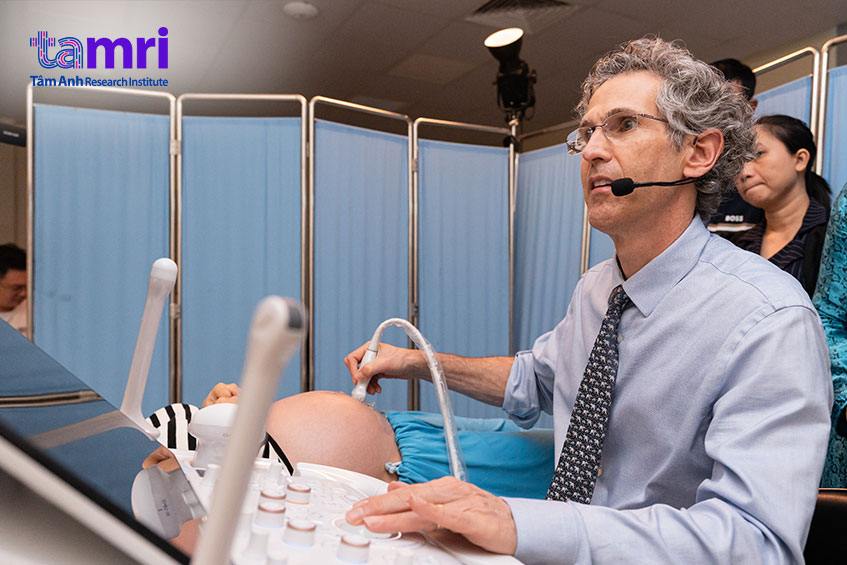
Prof. Sklansky conducted a live demonstration of ultrasound techniques during the conference.
Regarding fetal cardiac interventions, Prof. Sklansky shared several notable global advances, such as the treatment of severe aortic valve stenosis, a condition carrying a risk of progressing into hypoplastic left heart syndrome. This syndrome has a significantly poorer prognosis compared to isolated aortic valve stenosis.
Therefore, in a small subset of fetuses diagnosed with critical aortic stenosis, specialists may perform in-utero interventions involving balloon valvuloplasty of the fetal aortic valve to prevent the progression to hypoplastic left heart syndrome. This procedure is currently performed at only a limited number of advanced medical centers worldwide and benefits only a very small group of congenital heart disease patients.
However, the greatest benefit of prenatal detection of congenital heart disease lies not in altering the course of the condition while the infant is still in the womb, but in enabling early diagnosis, counseling families, and planning optimal postnatal care. This includes ensuring an appropriate delivery plan and being fully prepared for any immediate interventions necessary after birth. Without prenatal diagnosis, many cases can deteriorate significantly compared to those that are identified and managed in advance.
Therefore, to avoid missing congenital heart defects, it is essential to examine the fetal heart properly, using the correct angles and techniques, and to allocate sufficient time for a fetal echocardiography.
However, according to the Professor, achieving this goal requires a joint effort from many stakeholders, from training groups of physicians and healthcare professionals to implementing nationwide diagnostic and screening programs.
This responsibility may fall to the government or, in some cases, to a specialized general hospital tasked with establishing standardized certification frameworks, professional oversight systems, and continuous training programs. The aim is to build a robust workforce capable of performing advanced fetal heart screening not only in major cities but also in rural areas across the country.
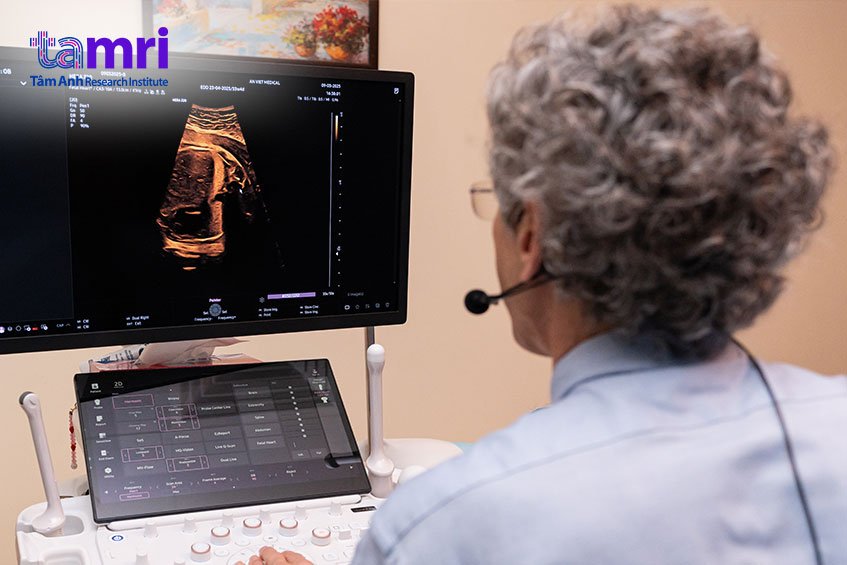
Professor Sklansky conducted demonstrations and guided fetal echocardiography techniques during the conference.
The Professor noted that Vietnam has made significant progress over the past 10 to 20 years, with marked improvements in the early prenatal detection of congenital heart disease. However, to further optimize outcomes for the majority of children born with congenital heart defects, nationwide training and professional development need to continue.
“This is a major challenge not only for Vietnam but also for most countries around the world. However, I believe Vietnam has huge potential to further enhance its ability to detect congenital heart disease before birth.
This potential stems from the strong commitment of Vietnamese doctors and healthcare professionals to continuous learning and professional development. In Vietnam, there is a clear understanding of the importance of structured training, and a willingness to invest time, effort, and resources to build a nationwide network of skilled specialists and well-equipped medical facilities”, Professor Sklansky said.
The Professor added, “If I could offer one suggestion, it would be that the next key objective, not just for doctors but for the community and the country as a whole, should be to establish a standardized system for monitoring, certification, and quality assurance for those involved in fetal heart screening, similar to what other countries have implemented”.
In addition to theoretical knowledge, he emphasized that hands-on practice is critical in fetal heart screening training. “It’s like learning to ride a bike or learning to write; you can attend seminars or read all the materials available, but if you don’t get on the bike or pick up the pen, you won’t truly learn.
Similarly, in fetal heart screening, training must involve practical guidance, where experts work directly with trainees and show them how to perform the ultrasound in real time. After that, what matters is consistent practice and continuous learning to truly master the techniques, because ultrasound skills are not only about thinking but also about your hand movements”.
At the conference, Professor Mark Sklansky performed fetal echocardiography on 4 pregnant women. One of the cases was Ms. Thanh, 32 years old, in her first pregnancy. A 21-week fetal morphology ultrasound conducted at the Fetal Medicine Center, Tam Anh HCMC General Hospital, indicated intrauterine growth restriction and raised concerns about an overriding aorta and a possible atrioventricular canal defect.
Professor Sklansky’s detailed fetal echocardiography at 23 weeks’ gestation identified a partial atrioventricular canal defect and double outlet right ventricle. He recommended close monitoring of the pregnancy to assess the fetus’s development. After birth, depending on the severity of the condition, the child may require surgical intervention for congenital heart disease at an appropriate time.
Another case was a 31-year-old pregnant woman in her second pregnancy, currently at 34 weeks’ gestation. During the fetal echocardiography, Professor Sklansky observed a discrepancy in size between the right and left ventricles, thickening of the right ventricular anterior wall, mild tricuspid regurgitation, and localized pericardial effusion in front of the right ventricle. Postnatal follow-up is required to monitor for cardiomyopathy, mild tricuspid valve regurgitation, and early-stage heart failure in the newborn.
In addition to the 2 aforementioned cases, Professor Sklansky also performed fetal echocardiography on two other pregnant women. The entire ultrasound procedures were broadcast live from the ultrasound room at the Tam Anh Research Institute (TAMRI) to the conference hall and streamed online, with more than 500 specialists and physicians across the country observing.

Professor Sklansky met and shared his experience with Vietnamese and international doctors and specialists during the conference.
At the conference’s conclusion, Professor Mark Sklansky expressed his gratitude to all the specialists and doctors who attended the conference. “It has truly been an honor for me, both professionally and personally. I’ve come from far away, from Los Angeles, to be here with all of you. While Los Angeles may be distant, my heart is here. I’m deeply moved by your passion and your eagerness to learn, and the remarkable progress you’ve made.
Thank you for your kindness. Everyone has treated me with such warmth and dedication. On behalf of all the speakers, I’d like to say this: if you’ve learned anything from this conference, I hope you bring that knowledge and those skills back into your clinical practice, to give children with congenital heart defects a better chance at a healthy life. That, to us, is the greatest privilege”.
Tam Anh Research Institute
- Ha Noi:
- 108 Hoang Nhu Tiep, Bo De Ward, Long Bien District, Ha Noi
- Hotline: 024 3872 3872 – 024 7106 6858
- Ho Chi Minh City:
- 2B Pho Quang Street, Ward 2, Tan Binh District, Ho Chi Minh City
- Hotline: 093 180 6858 – 0287 102 6789
- Website: https://tamri.vn/en/
Tam Anh Research Institute
- Ha Noi:
- 108 Hoang Nhu Tiep, Bo De Ward, Ha Noi
- Hotline: 024 3872 3872 – 024 7106 6858
- TP.HCM:
- 2B Pho Quang Street, Ward Tan Son Hoa, Ho Chi Minh City
- Hotline: 093 180 6858 – 0287 102 6789
- Fanpage: https://www.facebook.com/ViennghiencuuTamAnh.TAMRI
- Website: tamri.vn