

Alongside maintaining a healthy lifestyle, combination lipid-lowering therapy is considered a key strategy for controlling dyslipidemia and reducing atherosclerotic cardiovascular events in patients at high and very high cardiovascular risk.
This was the key message shared by Assoc. Prof. Pham Nguyen Vinh, MD, PhD, Vice President of the Vietnam National Heart Association and Director of the Cardiovascular Center at Tam Anh General Hospital Group in Ho Chi Minh City (HCMC), together with other speakers at the scientific symposium entitled “Dyslipidemia management according to the AHA 2026 guidelines: Key updates”, held on June 2, 2026, at the Tam Anh Research Institute, part of the Tam Anh General Hospital Group.

Optimizing lipid levels to reduce cardiovascular risk
Dyslipidemia is a major risk factor for a range of serious cardiovascular conditions, including coronary artery disease, atherosclerosis, and hypertension, which may lead to stroke and myocardial infarction. To effectively control blood lipid levels and prevent cardiovascular disease, the American Heart Association (AHA) emphasizes the principles of “the lower the LDL-C, the better” and “the earlier LDL-C is reduced, the better,” particularly in individuals at high and very high cardiovascular risk.

Assoc. Prof. Pham Nguyen Vinh, MD, PhD (center) with physicians and pharmacists at the scientific symposium “Dyslipidemia management according to the AHA 2026 guidelines: Key updates” on June 2, 2026.
In her presentation, “AHA 2026 Guidelines: Key Updates,” Dr. Tran Vu Minh Thu, Head of Cardiology Department 2 at the Cardiovascular Center, Tam Anh General Hospital Group in HCMC, noted that the 2026 recommendations jointly issued by the American College of Cardiology (ACC) and the American Heart Association (AHA) have fully replaced the 2018 cholesterol management guidelines. The updated recommendations emphasize early intervention to reduce long-term exposure to atherogenic lipoproteins, the use of the PREVENT-ASCVD risk assessment tool for cardiovascular risk stratification, the reintroduction of LDL-cholesterol (LDL-C) treatment targets, and measurement of lipoprotein(a) at least once in every adult. In addition to statins, newer lipid-lowering therapies, including ezetimibe, PCSK9 inhibitors, bempedoic acid, and inclisiran, play an important role in helping patients achieve LDL-C targets.

Dr. Tran Vu Minh Thu, MD, PhD emphasizes the importance of combination pharmacotherapy and lifestyle modification in achieving optimal LDL-C targets.
A key message from the new guidelines is the need to initiate lipid management early in order to minimize cumulative exposure to atherogenic lipoproteins. Individuals should adopt healthy lifestyle habits from a young age through a balanced diet, regular physical activity, avoidance of smoking and excessive alcohol consumption, and effective stress management. Pharmacological treatment may also be considered early in young adults with LDL-C levels ≥160 mg/dL or a family history of premature cardiovascular disease.
The 2026 recommendations also reintroduce specific LDL-C and non-HDL-C targets according to cardiovascular risk level while maintaining percentage-based LDL-C reduction goals. For secondary prevention in patients with established atherosclerotic cardiovascular disease, the LDL-C target is <55 mg/dL for very high-risk patients and <70 mg/dL for those who are not classified as very high risk. For primary prevention in individuals without established disease, the LDL-C target is <100 mg/dL or a reduction of more than 50% from baseline for most high-risk groups. This approach supports individualized treatment and optimizes the prevention of atherosclerotic cardiovascular disease.
Combination therapy for better lipid control
In her presentation, “Clinical case report: Fixed-dose combination therapy with rosuvastatin and ezetimibe,” Dr. Ho Thi Tuyet Mai from the Cardiovascular Center of Tam Anh General Hospital in HCMC highlighted the role of fixed-dose combination therapies containing a high-intensity statin such as rosuvastatin together with the cholesterol absorption inhibitor ezetimibe. Similarly, in her presentation “Clinical evidence on the rosuvastatin – ezetimibe fixed-dose combination,” Ms. Mai Anh Thu, Head of Drug Information and Communications at the Representative Office of EGIS Vietnam, emphasized that this new-generation lipid-lowering therapy represents a breakthrough solution that can improve treatment adherence and optimize cardiovascular protection for patients.

Dr. Ho Thi Tuyet Mai highlights the critical role of combination therapy in the management of dyslipidemia.
Dr. Mai presented a clinical case involving a 66-year-old man who experienced fatigue and left-sided chest discomfort during exertion. He had a history of hypertension, diabetes mellitus, and previous cerebral infarction. Clinical evaluation confirmed chronic coronary syndrome associated with dyslipidemia, placing him in the very high-risk category for atherosclerotic cardiovascular disease. However, the patient preferred medical treatment alone.
At the time, he was receiving statin therapy at a dose of 10 mg per day, yet his LDL-C level remained at 1.99 mmol/L, whereas the treatment target was below 1.0 mmol/L. The physician doubled the statin dose to 20 mg per day, resulting in a reduction of LDL-C to 1.37 mmol/L after two months. Although improved, this level still did not meet the target. Furthermore, the patient’s treatment chart demonstrated that doubling the statin dose provided only an additional 6% reduction in LDL-C at each step, while the risk of liver and muscle toxicity increased substantially.
To achieve LDL-C goals while minimizing the risk of hepatic and other organ-related adverse effects, the physician prescribed combination therapy with a statin and ezetimibe. At the one-month follow-up visit, the patient’s LDL-C level had decreased to 0.82 mmol/L.
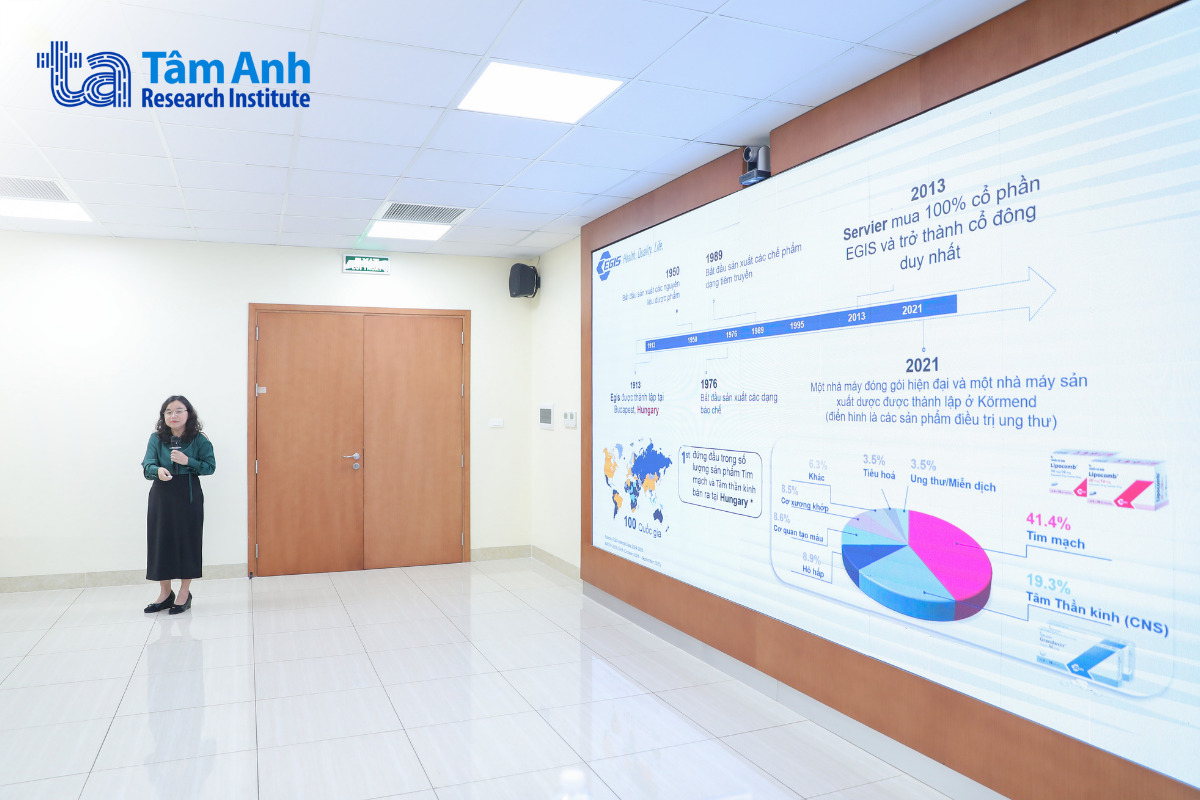
Ms. Mai Anh Thu presents on the mechanism of action and clinical efficacy of fixed-dose combination therapy in blood lipid management.
“The advent of fixed-dose combination therapies containing high-intensity statins such as rosuvastatin together with the cholesterol absorption inhibitor ezetimibe is considered a key strategy for achieving lipid targets earlier and maintaining long-term treatment effectiveness, thereby minimizing the risk of atherosclerotic cardiovascular disease,” Assoc. Prof. Vinh concluded.
The experts emphasized that the ultimate goal of dyslipidemia management is not merely to improve laboratory parameters but also to prevent myocardial infarction and stroke and ultimately extend patients’ lives. As the burden of cardiovascular disease continues to rise, the implementation of updated guidelines and optimization of combination therapy are expected to provide greater opportunities for effective cardiovascular risk reduction and protection of public health.
Tam Anh Research Institute
- Ha Noi:
- 108 Hoang Nhu Tiep, Bo De Ward, Ha Noi
- Hotline: 024 3872 3872 – 024 7106 6858
- TP.HCM:
- 2B Pho Quang Street, Ward Tan Son Hoa, Ho Chi Minh City
- Hotline: 093 180 6858 – 0287 102 6789
- Fanpage: https://www.facebook.com/ViennghiencuuTamAnh.TAMRI
- Website: tamri.vn