
The majority of liver cancer cases are detected at late stages when surgical intervention is no longer viable, leading to a poor prognosis. Personalized, multimodal combination therapies help increase treatment response and prolong patient survival.
At the seminar “Optimizing management practices for patients with unresectable hepatocellular carcinoma,” held on May 23 at the Tam Anh Research Institute, Dr. Phan Tan Thuan, Head of Clinical Affairs Department at Ho Chi Minh City Oncology Hospital, presented on “New advances in the treatment of unresectable hepatocellular carcinoma with dual immunotherapy: From mechanisms to clinical efficacy.” He emphasized that in liver cancer treatment, first-line therapy plays the most critical role.
Dr. Thuan shared that the liver is a vital organ performing over 500 functions, including the detoxification of metabolites and foreign substances; metabolism, blood sugar regulation, and the synthesis of essential substances; production of albumin and bile; blood filtration, blood clotting regulation, and infection resistance; as well as the storage of glucose, vitamins, and minerals.
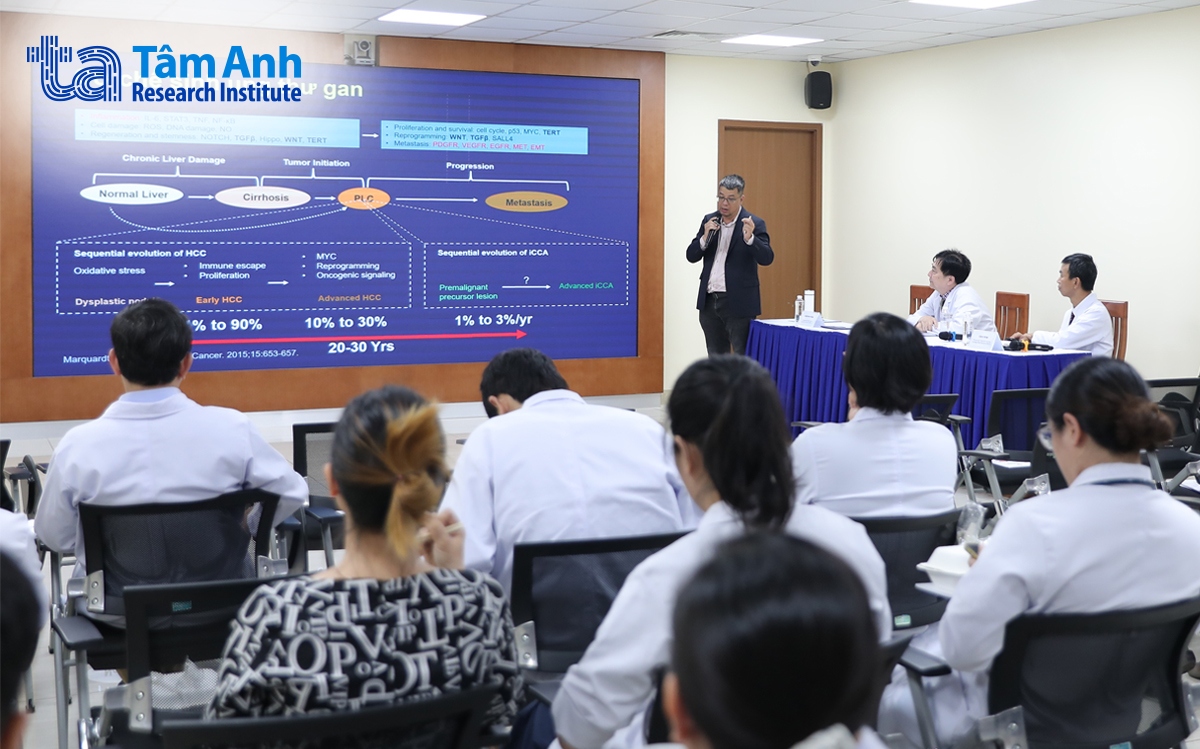
Dr. Phan Tan Thuan explained the mechanism of hepatocellular carcinoma oncogenesis, clarifying why immunotherapy is paramount in treating this disease.
Immunotherapy is crucial for late-stage liver cancer because inflammation and immune dysregulation are key factors contributing to hepatocellular carcinoma. In the future, experts aim to combine multiple immune mechanisms and treatment modalities to further enhance efficacy.
Dr. Le Tan Dat, Deputy Director of the Oncology Center at Tam Anh General Hospital in Ho Chi Minh City (HCMC), presented on “Personalized treatment and real-world data in unresectable hepatocellular carcinoma with dual immunotherapy.”
In treatment, personalization is essential to finding the optimal approach, reducing toxicity, and prolonging progression-free survival. This is because there are numerous causes of liver cancer and multiple factors driving the continuous growth of malignant cells. Furthermore, hepatocellular carcinoma typically develops on the background of chronic liver diseases such as fatty liver, hepatitis, and cirrhosis. Patients may also suffer from multiple comorbidities, and impaired liver function can limit tolerance to systemic therapies.

Dr. Le Tan Dat introduced the STRIDE regimen from the Himalaya study.
Currently, there are several standard treatments for unresectable liver cancer, among which “Dual IO” (a combination of two immunotherapy drugs) utilizing the STRIDE regimen is a prominent choice. Dual IO often yields a faster response compared to other treatment options (such as anti-angiogenic monotherapy, or a combination of one anti-angiogenic drug and one immunotherapy drug). The STRIDE regimen (in the HIMALAYA study) has reported 5-year overall survival data, while demonstrating a higher safety profile for patients at risk of bleeding, alongside consistent efficacy regardless of liver function.
Dr. Tran Hai Binh, Deputy Head of the Oncology Department at Tam Anh General Hospital in Hanoi, presented on “Comprehensive management in the treatment of unresectable hepatocellular carcinoma with dual immunotherapy,” integrated with real-world clinical case studies.
In the case of chemotherapy, chemotherapeutic agents are cytotoxic to cells, meaning side effects such as vomiting, diarrhea, anemia, and leukopenia can occur immediately during infusion or within a short period of 1-2 weeks afterward. In contrast, immunotherapeutic drugs activate the body’s immune system upon administration, with side effects typically manifesting after 4-6 weeks. Immunotherapy-related adverse events are inflammatory in nature, including dermatitis, skin rash, pneumonitis, adrenal insufficiency, and endocrine disorders. Therefore, patients require close monitoring post-treatment; severe cases may necessitate corticosteroid therapy or the discontinuation of immunotherapy. However, most of these side effects are manageable, and immunotherapy is generally considered more tolerable than chemotherapy.
Dr. Hai Binh shared a clinical case where dual immunotherapy treatment has been maintained for over 12 months, achieving a near-complete imaging response (liver lesions disappeared, and liver imaging returned almost to normal). The patient experienced minimal toxicity, including adrenal insufficiency, which was well-controlled with hormone replacement therapy.

Dr. Bui Le Phuoc Thu Thao, evaluated the efficacy of Stereotactic Body Radiation Therapy (SBRT) in the treatment of unresectable liver cancer.
During the seminar, experts engaged in lively discussions regarding advancements in treating unresectable liver cancer.
Dr. Thi Van Gung, Deputy Director of the Vascular Intervention Center and Head of the Endovascular Intervention Unit at the Center for Diagnostic Imaging and Interventional Radiology, shared insights on combining therapies to transform an advanced liver cancer case, initially beyond the scope of local treatment, into a locally controlled one. The key lies in multidisciplinary collaboration to appropriately integrate local treatments with systemic therapies.
Dr. Ho Si Minh, Head of the Liver Tumor Unit at the Oncology Center, Tam Anh General Hospital in HCMC, discussed the role of multidisciplinary consultations and the importance of evaluating liver function through various methods. Dr. Minh also provided insights into the newly updated Barcelona 2026 treatment guidelines, noting that this update explicitly highlights the role of stereotactic body radiation therapy in liver cancer treatment.
Dr. Bui Le Phuoc Thu Thao, a radiation oncology expert at Tam Anh General Hospital, further discussed stereotactic body radiation therapy, emphasizing that this modern technique effectively treats liver cancer from the early stages or when surgery is impossible. It successfully destroys tumors while minimizing damage to healthy tissue. Radiation therapy can be performed even when the tumor is located near large blood vessels, causes adjacent vascular damage, or leads to portal vein thrombosis. Numerous studies indicate that administering radiation therapy prior to drug treatment helps increase response rates.
Dr. Pham Xuan Dung, Director of the Oncology Center at Tam Anh General Hospital in HCMC, acknowledged that despite significant modern medical advancements in cancer diagnosis and treatment, liver cancer remains a formidable challenge. In the early stages, patients have a chance of being cured through methods such as surgery, embolization, and tumor ablation. However, in reality, up to 70% of cases are detected at late stages, when surgical intervention is no longer indicated. Currently, the median survival rate ranges from 16 to 22 months, and the 5-year survival rate is only 20%. Current treatment aims to reduce mortality and prolong progression-free survival.

Dr. Pham Xuan Dung, highly appreciated the integration of existing liver cancer treatment modalities within the Tam Anh General Hospital Group.
Tam Anh General Hospital Group is equipped with facilities and means that allow for the combined execution of virtually all liver cancer treatment methods, spanning from very early stages to unresectable advanced stages. In particular, the hospital’s in-house multidisciplinary consultation process serves as a core professional strength, enabling doctors to identify the best possible treatment pathways for patients.
Dr. Pham Xuan Dung expressed optimism that future advancements in new research and multimodal combinations will increase response rates and improve the quality of life for patients with advanced-stage liver cancer.
Tam Anh Research Institute
- Ha Noi:
- 108 Hoang Nhu Tiep, Bo De Ward, Ha Noi
- Hotline: 024 3872 3872 – 024 7106 6858
- TP.HCM:
- 2B Pho Quang Street, Ward Tan Son Hoa, Ho Chi Minh City
- Hotline: 093 180 6858 – 0287 102 6789
- Fanpage: https://www.facebook.com/ViennghiencuuTamAnh.TAMRI
- Website: tamri.vn