On December 13, 2025, the Tam Anh Research Institute, in collaboration with the Department of Science, Technology and Training (under the Ministry of Health) and the National Ethics Council, organized a specialized training course on Good Clinical Practice (GCP), Ethics in Biomedical Research, and Safety Reporting. This event demonstrates the commitment of the Tam Anh General Hospital System to enhancing the quality of scientific research and ensuring the maximum rights and safety of patients.

The program attracted nearly 150 experts and doctors to attend in person at the auditorium of the Tam Anh Research Institute. Delivering the opening remarks, Assoc. Prof. Dr. Tran Quang Binh, Director of the Center for Training and Scientific Research, Tam Anh General Hospital Group HCMC, stated that this is a pivotal step that helps the medical team access international-standard, transparent scientific research procedures that prioritize patient benefits. This activity goes beyond the scope of a regular course; it is an important piece in Tam Anh’s sustainable development strategy: combining quality examination and treatment with cutting-edge research.

Dr. Tran Quang Binh delivers the opening speech for the program.
Dr. Binh also emphasized the special attention from State leaders and the Ministry of Health, particularly the Department of Science, Technology and Training, through their co-organization of the event with the Tam Anh Research Institute.
“The presence of such a large number of participants today is clear evidence of the eagerness to learn and the committed responsibility of Tam Anh’s healthcare staff in ensuring absolute safety for patients participating in clinical trials,” Dr. Binh added.
Assoc. Prof. Dr. Do Van Dung, Vice Chairman of the National Ethics Council, shared the importance of ethical standards amidst the major transformation of Vietnam’s medical field. The remarkable scientific and technological advancements achieved recently are the result of continuous efforts by various domestic organizations and institutions.
However, the more technology develops, the more ethics in research must be promoted. Strict adherence to quality standards and maximum protection of patient rights is not only a responsibility but also plays a key role in helping Vietnamese medicine deeply integrate into the world’s science and technology landscape, Assoc. Prof. Dr. Do Van Dung remarked.
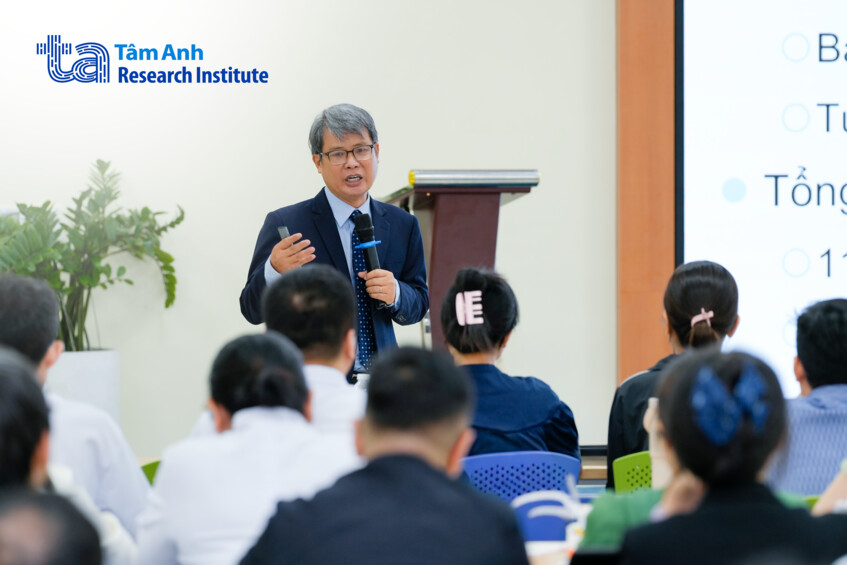
Dr. Do Van Dung presents on the topic: “Overview of ICH-GCP and Ethics in Biomedical Research.”
Good Clinical Practice (GCP) is the international ethical and scientific standard for designing, conducting, recording, and reporting clinical trials. The application of GCP is also a crucial foundation for the Vietnamese health system to enhance its reputation in the field of research. This is particularly relevant in the context of implementing Resolution 57-NQ/TW on breakthroughs in scientific and technological development, innovation, and national digital transformation, and Resolution 72-NQ/TW on several breakthrough solutions to strengthen the protection and care of public health.
In his speech, Assoc. Prof. Dr. Do Van Dung offered special gratitude to the Tam Anh Research Institute for its pioneering efforts in creating a professional research environment, contributing to elevating the position of the nation’s health sector.
Also at the training session, Dr. Nguyen Ngo Quang, Director of the Department of Science, Technology and Training – Ministry of Health, and Chief of Staff of the National Ethics Council, presented the development orientation for science and technology in the health sector, focusing on three main technology complexes. First is the Physical technologies, including 3D printing, Nanotechnology, and automation in production. Second is the Digital Technology complex, encompassing big data computing technology, the Internet of Things (IoT), and Artificial Intelligence (AI).
Finally, the Biotechnology complex is indispensable, featuring gene technology, stem cells, and cloning, opening a new era for regenerative medicine and the conservation of valuable medicinal genetic resources.
Dr. Nguyen Ngo Quang presents on the topic: “Scientific and Technological Research and Development in the Health Sector – Clinical Trial Research Approach – Development Orientation for Clinical Research Centers.”
He also emphasized the role of establishing standard Clinical Research Centers (CRCs) to meet the demands of new technology research and development. Researchers must strictly adhere to the approved protocols and ensure the safety of participants. All collected data must be accurate and truthful to ensure the best possible treatment outcomes for the community.
Dr. Phuong Le Tri, Executive Director of the Tam Anh Research Institute, presented on multi-center scientific research, stating that Tam Anh General Hospital and the Tam Anh Research Institute have implemented the VISTA-1 Project on the oral immunotherapy drug RBS2418 for cancer treatment, witnessed by representatives from the Ministry of Health, the Ministry of Foreign Affairs, and the US Centers for Disease Control and Prevention (CDC). This is a clinical study adhering to international standards, marking a new step in the strategy to provide Vietnamese patients with early access to advanced treatment therapies.
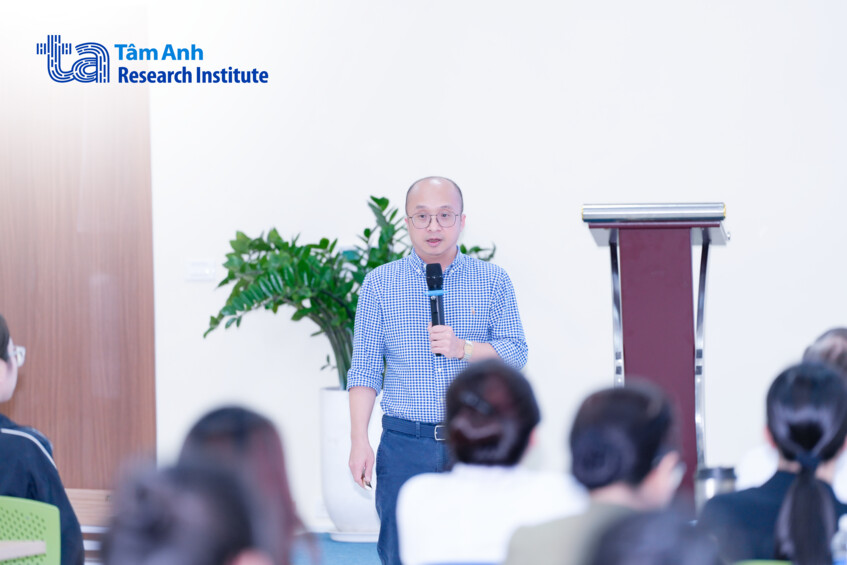
Dr. Phuong Le Tri presents at the program.
“The effort to bring this potential drug to Vietnam is a precious opportunity for patients, giving them a chance to live healthier lives. Vietnamese doctors and scientists also gain the opportunity to learn highly professional, rigorous, and high-level procedures for new drug research and development,” Dr. Tri emphasized.
During the training session, Vo Thi Nhi Ha, PhD from the National Ethics Council specifically highlighted the importance of managing adverse events (AEs) and serious adverse events (SAEs) as a “yardstick” for research ethics. Concurrently, the source documentation management process was thoroughly mandated, accurate, original, and timely (ALCO principles). This requires all data, from medical records to lab results, to be transparent, traceable, and strictly without erasure or alteration, ensuring the integrity of the research results.

Vo Thi Nhi Ha, PhD presents on the topic: “Source Documents and Essential Documents.”
Beyond technical factors, the humanitarian aspect was prioritized through the standard of the “informed consent document.” This is not merely an administrative procedure but a “commitment” to protect human rights, mandatorily including 20 core elements such as the study’s purpose, procedure, potential risks, and the right to withdraw at any time. Investigators are required to explain the information clearly and thoroughly, ensuring participants make decisions based on full understanding and complete free will, without any coercion or undue influence.
Concluding the program, the Tam Anh Research Institute once again affirmed its commitment to ethical and transparent scientific research, with the ultimate goal of safeguarding community health and safety.
Tam Anh Research Institute
- Ha Noi:
- 108 Hoang Nhu Tiep, Bo De Ward, Ha Noi
- Hotline: 024 3872 3872 – 024 7106 6858
- TP.HCM:
- 2B Pho Quang Street, Ward Tan Son Hoa, Ho Chi Minh City
- Hotline: 093 180 6858 – 0287 102 6789
- Fanpage: https://www.facebook.com/ViennghiencuuTamAnh.TAMRI
- Website: tamri.vn