
While early-stage colorectal cancer is highly manageable and often curable, treating advanced stages remains a significant clinical challenge. During a recent scientific seminar at Tam Anh Research Institute, Tam Anh General Hospital System entitled “Updates on advanced colorectal cancer treatment,” medical experts presented research findings aimed at enhancing therapeutic outcomes for patients.

Colorectal cancer is the second leading cause of cancer-related mortality worldwide. In early stages, the disease can be well controlled. For example, when malignant cells remain localized and have not spread to surrounding tissues or lymph nodes, the five-year survival rate can reach up to 90%. In cases of regional disease, where cancer has spread to nearby lymph nodes or adjacent organs, the five-year survival rate is approximately 71%. In advanced stages with distant metastases to organs such as the liver, lungs, or brain, this rate drops to around 14%.
Dr. Le Tan Dat, Deputy Director of the Oncology Center at Tam Anh General Hospital HCMC, noted that roughly 30% of colorectal cancer patients present with metastasis at the time of initial diagnosis.
Dr. Tan Dat shares the personalized multimodal treatment protocol, which integrates advanced therapies such as targeted drugs and immunotherapy.
Personalized Multimodal Therapy
In advanced cases with distant metastasis, standard chemotherapy remains the cornerstone of treatment. Depending on the patient’s condition, doctors develop personalized multimodal protocols that integrate modern therapies such as targeted drugs and immunotherapy. The combination of genetic testing and local treatment modalities such as surgery and radiotherapy to control metastatic lesions is now essential in extending quality of life. It is now essential in extending quality of life.
Furthermore, integrating the continuum of care model has significantly improved survival outcomes.
Experts are also intensifying research to further refine these prognoses. Dr. Dat introduced the KEYNOTE-177 trial, a multicenter, randomized, open-label study investigating the efficacy of Pembrolizumab monotherapy as a first-line treatment for MSI-H/dMMR colorectal cancer. Results demonstrated that Pembrolizumab reduces the risk of disease progression or death by 40% compared to standard chemotherapy.
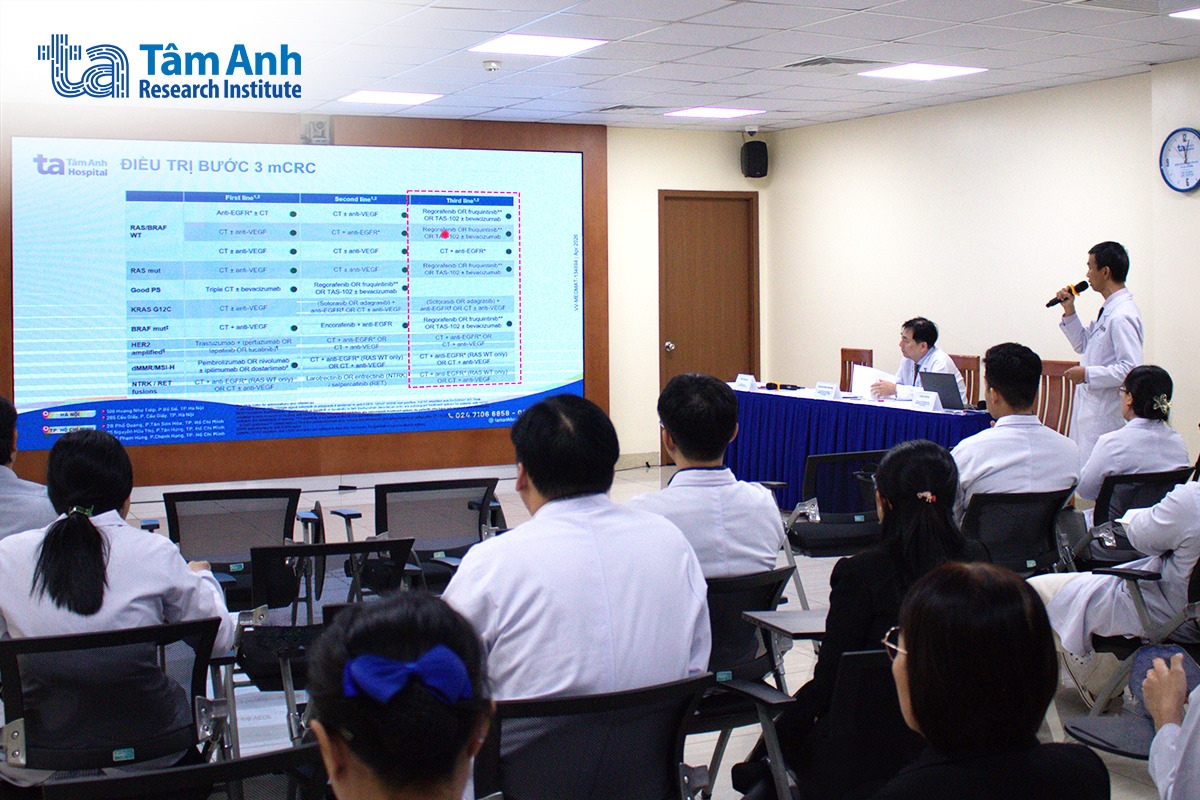
Dr. Vu Huu Khiem, Head of the Oncology Department at Tam Anh General Hospital Hanoi, presented the FRESCO & FRESCO-2 studies on the efficacy of Fruquintinib. This oral medication, a selective inhibitor of vascular endothelial growth factor receptors (VEGFR 1, 2, and 3), showed significant improvements in progression-free survival (PFS) and overall survival (OS) compared to a placebo in Phase 3 clinical trials, maintaining a strong safety and tolerability profile.

Dr. Khiem presenting the FRESCO & FRESCO-2 studies on the efficacy of Fruquintinib in treating advanced colorectal cancer.
Dr. Khiem emphasized that modern approaches based on molecular biomarkers and prior treatments are successfully extending both the life expectancy and the quality of life for those with advanced disease.

Physicians from Tam Anh General Hospital Hanoi attended the scientific seminar virtually.
In Vietnam, a notable milestone is the Vista-1 research project, which received FDA clearance in September 2024 and was licensed by the Ministry of Health for implementation at Tam Anh General Hospital in December 2024. This Phase 2A study focuses on RBS2418, an oral immunotherapy drug designed for end-stage cancer patients who no longer respond to current therapies.
RBS2418 works by activating the body’s immune system to recognize and destroy cancer cells by converting the tumor’s immune status from “cold” to “hot.” The drug proved safe during preclinical stages and showed no significant side effects in Phase 1 clinical trials conducted at over 10 prestigious U.S. medical institutions. The Vista-1 project is currently recruiting eligible patients.
Dr. Pham Xuan Dung, Director of the Oncology Center at Tam Anh General Hospital HCMC, observed that surgery still plays a role in some Stage 4 cases. Patients may receive a combination of chemotherapy and targeted therapy, followed by surgery when the lesions become resectable. During this process, Multidisciplinary Team (MDT) consultations are vital for determining the most accurate and cost-effective treatment paths.

Dr. Xuan Dung evaluating the current clinical landscape of late-stage colorectal cancer and expressing optimism for future breakthrough research.
While immunotherapy shows initial promise, targeted therapies and angiogenesis inhibitors are already widely used in Vietnam, often alongside chemotherapy. Although patients may eventually develop drug resistance, the emergence of next-generation medications offers clear benefits.
For instance, the anti-angiogenic drug Fruquintinib has statistically improved late-stage survival by 2–3 months, a modest but meaningful advancement. As medical technology continues to evolve, there is high hope for new drugs that will further elevate the prognosis and quality of life for cancer patients.
Tam Anh Research Institute
- Ha Noi:
- 108 Hoang Nhu Tiep, Bo De Ward, Ha Noi
- Hotline: 024 3872 3872 – 024 7106 6858
- TP.HCM:
- 2B Pho Quang Street, Ward Tan Son Hoa, Ho Chi Minh City
- Hotline: 093 180 6858 – 0287 102 6789
- Fanpage: https://www.facebook.com/ViennghiencuuTamAnh.TAMRI
- Website: tamri.vn