
On April 19, the conference titled “Advances in Multimodal Management of Pelvic Floor Dysfunction and Low Back Pain” was successfully held by the Tam Anh Research Institute (TAMRI), in collaboration with the Orthopedic Trauma Center under Tam Anh General Hospital Group. The event shared modern and effective approaches for managing these conditions.
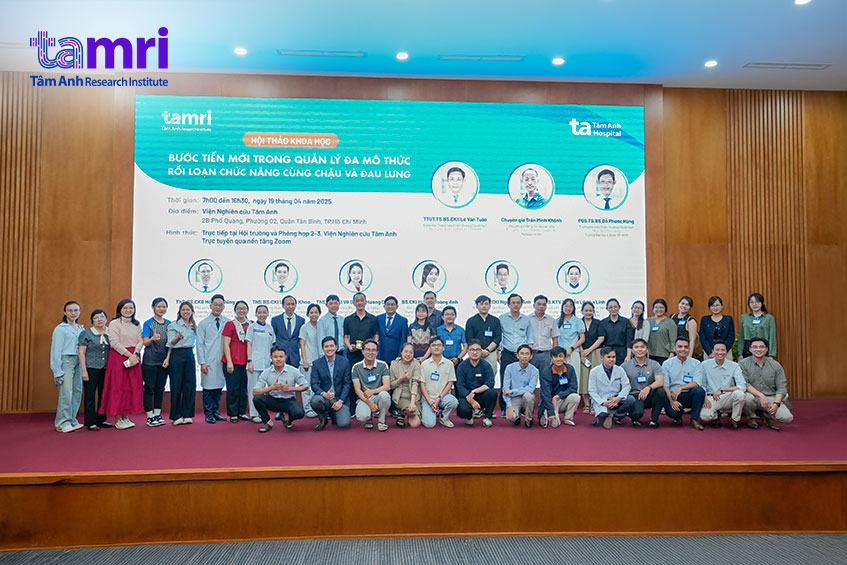
The conference drew wide participation from doctors, specialists, and healthcare providers.
During the conference, leading specialists presented in-depth topics, including: The role of pharmacological coordination in managing low back pain, assessment and surgical treatment of sacroiliac joint pain, manual therapy and exercise-based rehabilitation for sacroiliac dysfunction, the application of physiotherapy devices in treating sacroiliac dysfunction and lower back pain,…
The Conference was chaired by: MD, PhD Le Van Tuan (Director of Neuroscience Center in Tam Anh General Hospital – Ho Chi Minh City) and Assoc. Prof. Dr. Do Phuoc Hung (Head of the Department of Orthopedic Trauma and Rehabilitation in University of Medicine and Pharmacy at HCMC).

Assoc. Prof. Dr. Do Phuoc Hung and MD, PhD Le Van Tuan
In his speech, Dr. Le Van Tuan noted that 80% of adults experience lower back pain at least once in their lifetime, with sacroiliac joint dysfunction (SIJD) accounting for 10–30% of these cases. While not life-threatening, SIJD can cause chronic pelvic and lower back pain, impair mobility, and lead to spinal complications. Early detection and effective management are essential to improving patients’ quality of life.
The sacroiliac joint—the body’s largest joint—plays a vital role in distributing weight evenly across the legs, stabilizing the spine, supporting posture, and absorbing impact during movement. It can be damaged by trauma, degeneration, spinal deformities, pregnancy, or surgery. Structurally, the sacroiliac joint acts as a force-transmitting intermediary, closely linked to the spine and hip joints. Dysfunction in any of these three structures can disrupt the others. Diagnosing SIJD remains challenging due to its varied and easily overlooked symptoms.
“During patient evaluations, physicians must thoroughly investigate lifestyle, occupation, and injury history. Attention should extend beyond the sacroiliac joint to the hips, spine, and surrounding muscles,” emphasized Senior Physical Therapist Tran Minh Khanh from Lakeside Sports Medicine Center (Australia).

Numerous physicians and medical staff participated, actively engaging with the presentations.
“Approximately 40% of acute sacroiliac joint pain cases progress to chronic conditions due to inadequate treatment, leading to loss of mobility and reduced quality of life,” stated Dr. Le Dinh Khoa, Head of the Joint Reconstruction Department at Tam Anh General Hospital HCMC. Multimodal management is the recommended first-line treatment approach for sacroiliac joint dysfunction. This method combines various therapies to optimize pain relief and functional improvement. It represents a comprehensive strategy that addresses not only symptoms but also root causes and contributing factors, thus reducing recurrence risks.
The multimodal approach includes medication (oral and injectable), physical therapy, and surgical intervention (as a last resort when conservative treatments fail). Physical therapy is the primary treatment, while medications help manage symptoms to facilitate rehabilitation. Surgery is only considered when conservative measures prove ineffective.

Dr. Le Dinh Khoa
The hands-on training session emerged as a key highlight of the Conference, focusing on two main components: Manual assessment and treatment of sacroiliac joint dysfunction and Evaluation techniques with management of sacroiliac dysfunction and low back pain. These interactive sessions were expertly guided by Specialist Tran Minh Khanh and medical support staff from Tam Anh Hospital.

Specialist Tran Minh Khanh
During the practical segment, rehabilitation specialists from the Traumatology and Orthopedics Center at Tam Anh General Hospital (HCMC) demonstrated cutting-edge physiotherapy technologies integrated into multimodal treatment protocols for sacroiliac dysfunction, including: High-power laser therapy for inflammation reduction and tissue regeneration; shockwave therapy to break down fibrotic tissue and relieve pain; radiofrequency (RF) therapy for targeted pain management and functional improvement. These advanced techniques have proven highly effective in pain control and functional recovery for patients.
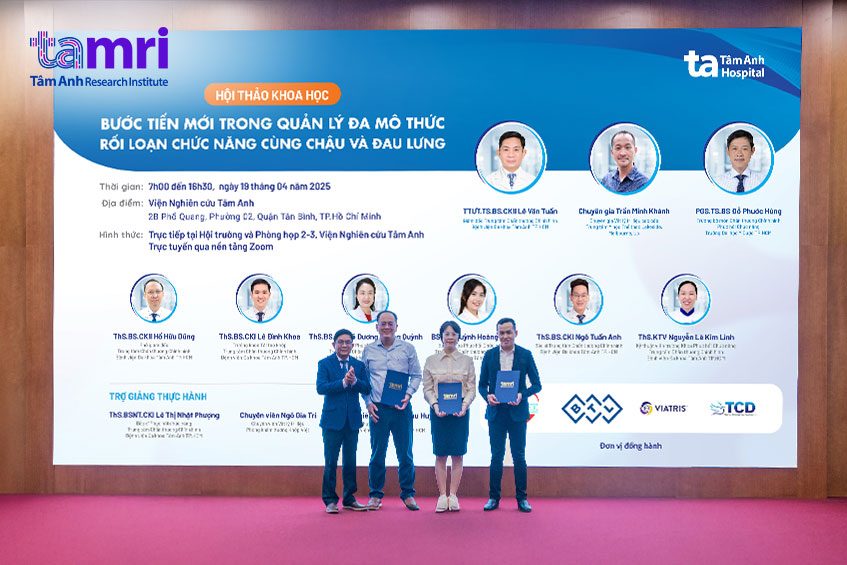
MD, PhD Le Van Tuan along with sponsoring organizations
Through its commitment to innovation and adoption of progressive medical advancements, the Traumatology and Orthopedics Center at Tam Anh General Hospital Group reinforces its leadership in applying modern technologies for musculoskeletal diagnosis and treatment. This approach delivers optimal, long-term therapeutic solutions while reducing both patient burden and healthcare costs.
Scientific Conference: “Advances in Multimodal Management of Pelvic Floor Dysfunction and Low Back Pain” brought together leading experts in Orthopedic Trauma and Rehabilitation who delivered in-depth presentations on topics such as:
- Ho Huu Dung, MD, MSc – Deputy Director, Department of Traumatology and Orthopedics (Tam Anh General Hospital HCMC): Overview of assessment and treatment for sacroiliac joint pain
- Le Dinh Khoa, MD, MSc – Head, Joint Reconstruction Department (Tam Anh General Hospital HCMC): Medication use in lower back and sacroiliac joint pain
- Vo Duong Huong Quynh, MD, MSc – Deputy Head, Rehabilitation Department and Nguyen Le Kim Linh, MD – Chief Technician, Rehabilitation Department (Tam Anh General Hospital HCMC): Physical modalities approach to sacroiliac joint pain and dysfunction
- Specialist Tran Minh Khanh, Lakeside Sports Medicine Center (Australia): Assessment in sacroiliac joint dysfunction and imbalance; Conservative treatment for sacroiliac joint dysfunction – Manual therapy and Therapeutic exercises
- Nguyen Le Kim Linh, MSc – Chief Technician, Rehabilitation Department (Tam Anh General Hospital HCMC): Applications of physical modalities in lower back and sacroiliac joint dysfunction
- Ngo Tuan Anh, MD, MSc – Department of Traumatology and Orthopedics: Injection therapy for sacroiliac joint pain relief
- Huynh Hoang Anh, MD – Rehabilitation Department (Tam Anh General Hospital HCMC): Anatomy, kinesiology, and biomechanics of the lumbopelvic complex.
Tam Anh Research Institute
- Ha Noi:
- 108 Hoang Nhu Tiep, Bo De Ward, Ha Noi
- Hotline: 024 3872 3872 – 024 7106 6858
- TP.HCM:
- 2B Pho Quang Street, Ward Tan Son Hoa, Ho Chi Minh City
- Hotline: 093 180 6858 – 0287 102 6789
- Fanpage: https://www.facebook.com/ViennghiencuuTamAnh.TAMRI
- Website: tamri.vn