
For patients with Acute Coronary Syndrome (ACS), even after successful intervention and treatment, approximately 15% still face the risk of a recurrent event within the first year. Therefore, maintaining stable LDL-cholesterol (LDL-C) levels has become an urgent requirement to better protect patients against future complications.
Assoc. Prof. Pham Nguyen Vinh, MD, PhD, Director of the Cardiovascular Center at Tam Anh General Hospital HCMC, emphasized this at the scientific seminar “Updating Dyslipidemia Management in ACS Patients.” The event took place on February 28, 2026, at the Tam Anh Research Institute.
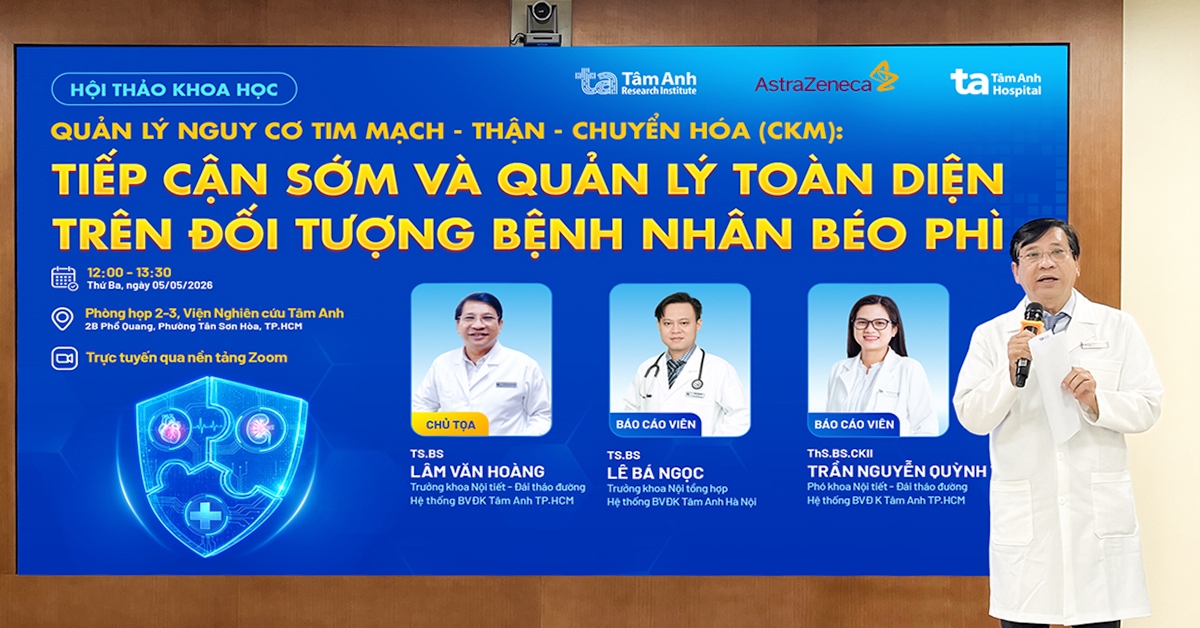
The seminar featured presentations from Dr. Lam Van Hoang, Dr. Huynh Thanh Kieu, and specialists from the Cardiology and Endocrinology & Diabetes departments.

Assoc. Prof. Pham Nguyen Vinh (center) with participating doctors and sponsor representatives at the scientific seminar on February 28.
Aiming for Safe LDL-C Levels
In his presentation, “Optimizing LDL-C Control in High-Risk Patients: From Guidelines to Practice,” Dr. Lam Van Hoang, Head of the Department of Endocrinology & Diabetes, noted that cardiovascular disease remains the leading cause of death in recent years, primarily due to cerebrovascular and ischemic heart diseases. A major risk factor is Acute Coronary Syndrome, caused by plaque buildup that narrows or completely obstructs the coronary arteries.
While the prognosis for ACS has significantly improved through advances in anti-thrombotic therapy, early intervention, and comprehensive coronary care, the risk of recurrence remains as high as 15% within 12 months of the initial event.
Dr. Hoang emphasized that LDL-C (bad cholesterol) is the primary driver of the formation and progression of atherosclerosis. Following an ACS event, every excess millimole of LDL-C in the blood acts as a potential “fuse” for subsequent cardiovascular events. Lowering LDL-C stabilizes plaque; thus, controlling this index is not merely about reaching a numerical target, but also plays a critical role in improving survival and preventing recurrent myocardial infarction or stroke.

Dr. Lam Van Hoang sharing insights on the risk of recurrent cardiovascular events due to suboptimal LDL-C management post-treatment.
Current guidelines state that “very high-risk” patients include those with clinically or radiologically confirmed atherosclerotic cardiovascular disease (ASCVD), diabetes with target organ damage, severe chronic kidney disease, or a very high 10-year cardiovascular risk score. For this group, the treatment goal is an LDL-C level below 1.4 mmol/L (55 mg/dL) and at least a 50% reduction from baseline. For cases with recurrent events despite optimal treatment, an even lower target may be considered.
Standardized Lipid Management Model for Very High-Risk Patients
Dr. Huynh Thanh Kieu, MSc, MD, Head of Cardiology Department 1, Cardiovascular Center, Tam Anh General Hospital HCMC — presented a comprehensive overview of “Updates in Acute Coronary Syndrome (ACS) Management Based on the Latest Clinical Guidelines.” Her presentation provided participants with essential updates on international treatment standards aimed at improving patient survival outcomes.

Dr. Huynh Thanh Kieu presenting the latest treatment protocols for acute coronary syndrome management.
Guidelines emphasize an early and intensive treatment strategy: initiating high-intensity statins during hospitalization for ACS patients and reassessing lipid levels after 4–8 weeks. If the LDL-C target is not met, non-statin therapies, such as ezetimibe or PCSK9 inhibitors (including monoclonal antibodies and siRNA), should be added. Early combination therapy increases the likelihood of reaching LDL-C goals and reduces the risk of recurrence.
Based on these international foundations, the Cardiovascular Center at Tam Anh General Hospital HCMC has implemented a standardized lipid management model for very high-risk patients. This initiative aims to bridge the gap between clinical guidelines and actual practice.
Following the “The Lower, The Better” principle, the model is designed around “Early Intervention, Low Targets, and Sustainable Maintenance.” The synchronized process includes: Standardizing risk stratification; Establishing LDL-C targets from the outset; Prioritizing high-intensity treatment and early combination therapy; Re-testing lipid levels at the 4–8 week mark; Promptly adjusting regimens to eliminate clinical inertia.
Initial results from a study of 303 patients showed that the rate of achieving LDL-C targets below 1.4 mmol/L increased by 5.4% after the first follow-up visit (from 27.4% to 32.7%). Although the follow-up period is brief, this improvement reflects the model’s effectiveness in standardizing treatment.

Medical experts engaging in professional exchange and clinical discussions during the seminar.
“To manage LDL levels within a safe range, high-intensity statins alone may be insufficient for many patients, especially those at high or very high cardiovascular risk. Therefore, early and aggressive combination therapy with additional agents, such as PCSK9 inhibitors, is necessary to reach LDL targets quickly, deeply, and sustainably,” concluded Assoc. Prof. Pham Nguyen Vinh.
Tam Anh Research Institute
- Ha Noi:
- 108 Hoang Nhu Tiep, Bo De Ward, Ha Noi
- Hotline: 024 3872 3872 – 024 7106 6858
- TP.HCM:
- 2B Pho Quang Street, Ward Tan Son Hoa, Ho Chi Minh City
- Hotline: 093 180 6858 – 0287 102 6789
- Fanpage: https://www.facebook.com/ViennghiencuuTamAnh.TAMRI
- Website: tamri.vn