
The signing ceremony between TAMRI and ViRx@Stanford is seen as a significant event that solidifies cooperation between Vietnam and the United States in human health care.
President Vo Van Thuong visited Stanford University on the afternoon of November 15 (local time). During his visit, he witnessed the announcement of an essential collaboration between the ViRx@Stanford, a Stanford biosecurity and pandemic preparedness initiative, and the TAMRI Research Institute, a division of Tam Anh General Hospital Group. This collaboration entails conducting a clinical trial in Vietnam to evaluate the efficacy of a novel medication for hepatitis D.
The event occurred before President Vo Van Thuong participated in the 2023 APEC. At the ceremony, he emphasized the critical proclamation made in September, in which Vietnam and the United States elevated their relations to a comprehensive strategic partnership. Cooperation in health and human health care is crucial to the commitments. It is also essential to recognize that the successful implementation of any significant agreement requires the active collaboration of local communities, organizations, and enterprises.
The signing event between TAMRI and ViRx@Stanford is a significant step towards achieving common goals in the field of health care. This event marks the realization of the strategic objectives outlined in the agreement signed in September during President Joe Biden’s visit to Vietnam.
The goals include fostering collaboration in training, research, and development of biotechnology and advancing the research and development of preventive and therapeutic drugs. Additionally, the aim is to leverage artificial intelligence (AI) technology and establish a cutting-edge laboratory system for drug clinical trials at TAMRI, adhering to rigorous standards set by Stanford.
President Vo Van Thuong lauded the partnership between ViRx@Stanford and Tam Anh General Hospital Group, a leading healthcare provider in Vietnam. They work together to study disease prevention, develop innovative cancer drugs, and implement early virus screening.
“This collaboration is significant as it spans research to commerce and, most importantly, leads to new advancements in human health care. I hope that this collaboration will soon produce significant outcomes and fulfill the important commitments of the leaders of Vietnam and the United States, making a positive contribution to the cause of protecting, caring for, and enhancing the health of the people,” President Vo Van Thuong said, expressing his strong commitment to supporting and collaborating with units to overcome any challenges and obstacles to achieve positive outcomes in this cooperation.
David Entwistle, president and CEO of Stanford Health Care, expressed his appreciation for the opportunity to welcome President Vo Van Thuong and the delegations attending this significant international-scale event between research institutes. In the biomedical technology revolution, he stressed the importance of collaborative efforts within the Stanford healthcare system, Tâm Anh General Hospital Group, and Tam Anh Research Institute.
These partnerships showcase the ability to bring together world-class units to conduct cutting-edge research. He is confident that working with TAMRI and Tam Anh General Hospital Group will lead to scientific breakthroughs that will significantly improve community health.
Professor Ruth O’Hara, senior associate dean for research at Stanford University School of Medicine, emphasized the importance of bringing together top-notch research units to tackle pressing health challenges on a global scale. This approach reflects the Stanford healthcare system’s commitment to significantly impacting the field.
Professor Jeffrey Glenn, director of ViRx@Stanford and director of the Center for Hepatitis and Liver Tissue Engineering at Stanford University School of Medicine, recently visited the Tâm Anh General Hospital to observe the modern medical infrastructure and meet with the dedicated team of doctors and staff here. He was particularly impressed by the efforts in researching and developing innovative drugs to combat diseases caused by viruses, with a particular focus on hepatitis viruses.
He was impressed by TAMRI’s impressive portfolio, which included Vietnam’s top hospital system, a renowned research institute, and a vast network of vaccination centers nationwide. In addition, he emphasized the importance of being prepared for pandemics and developing fundamental scientific capabilities, which makes it a perfect match for Stanford.
The event focused on the crucial topic of screening for hepatitis D virus infection, which was a key highlight of the scientific and training collaboration between ViRx@Stanford and TAMRI. There are currently over 10 million individuals in Vietnam living with chronic hepatitis B. Research indicates that individuals who are co-infected with hepatitis B and D viruses face a significantly increased risk of developing liver fibrosis and liver cancer.
There is a suspected link to the hepatitis D virus. Unfortunately, testing for hepatitis D has not been conducted in Vietnam. The training on hepatitis D testing techniques from Stanford will significantly contribute to Vietnam’s strategy for managing viral hepatitis, resulting in significant patient benefits. Understanding the hepatitis D infection in Vietnam provides crucial information to scientists globally, aiding in developing potential treatments for this dangerous disease.
In a statement, Professor Nguyen Van Tuan, executive director of Tam Anh Research Institute, emphasized the importance of training activities, staying updated with scientific knowledge, and embracing hepatitis D testing as a means for Vietnamese doctors to engage in new scientific endeavors. At the same time, it enables American scientists to gather valuable insights from clinical practice, which greatly contributes to the study of diseases and the development of effective examination and treatment methods.
TAMRI carefully chose a team of exceptional experts and doctors from Hanoi and Ho Chi Minh City to undergo comprehensive training at Stanford. This training covered clinical skills, such as examination and treatment, and laboratory testing techniques.
The presence of three major general hospitals in Hanoi and Ho Chi Minh City, along with TAMRI’s modern laboratory system and highly skilled personnel team, allows for the efficient implementation of essential testing techniques like hepatitis D on a large scale. This capability was achieved through comprehensive training from Stanford.
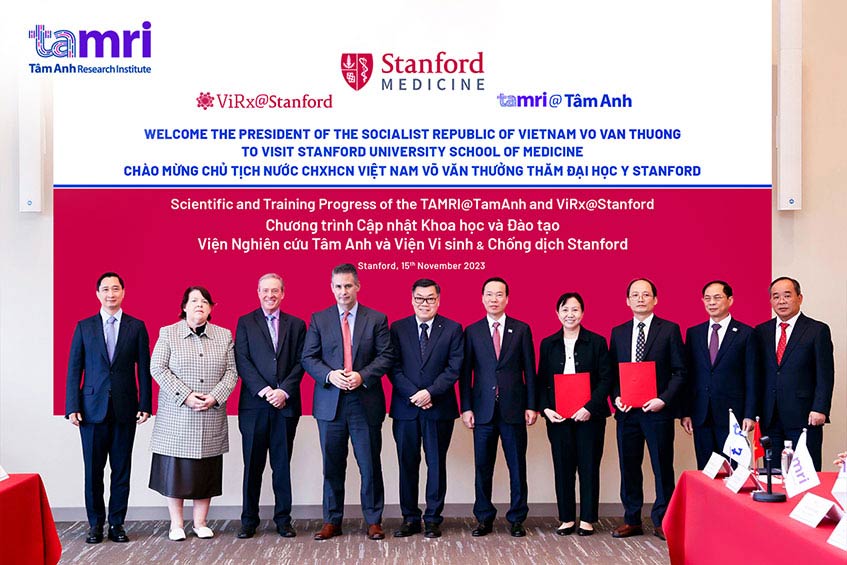
President Vo Van Thuong and Vietnamese delegates visit Stanford University, where the first hepatitis D testing training for Vietnam is announced

President Vo Van Thuong shakes hands with a representative from ViRx@Stanford
Tam Anh Research Institute
- Ha Noi:
- 108 Hoang Nhu Tiep, Bo De Ward, Long Bien District, Ha Noi
- Hotline: 024 3872 3872 – 024 7106 6858
- Ho Chi Minh City:
- 2B Pho Quang Street, Ward 2, Tan Binh District, Ho Chi Minh City
- Hotline: 093 180 6858 – 0287 102 6789
- Website: https://tamri.vn/en/
Tam Anh Research Institute
- Ha Noi:
- 108 Hoang Nhu Tiep, Bo De Ward, Ha Noi
- Hotline: 024 3872 3872 – 024 7106 6858
- TP.HCM:
- 2B Pho Quang Street, Ward Tan Son Hoa, Ho Chi Minh City
- Hotline: 093 180 6858 – 0287 102 6789
- Fanpage: https://www.facebook.com/ViennghiencuuTamAnh.TAMRI
- Website: tamri.vn