
Thuy, 33, diagnosed with intrauterine adhesions that caused infertility, underwent a laparoscopic surgery performed by doctors from Tam Anh General Hospital. The procedure was showcased during a live demonstration at a seminar focused on hysteroscopic surgery.

On October 11, Thuy’s hysteroscopic surgery was broadcast live from the operating room to the auditorium at Tam Anh Research Institute (TAMRI) as part of the scientific seminar titled “Hysteroscopy For The Treatment of Gynecologic Diseases.” The event was organized by Tam Anh General Hospital in HCMC and sponsored by Karl Storz Se & Co. KG’s Ho Chi Minh City office.
Over 100 experts and physicians attended the event, including:
- Prof. Lee Chyi-Long, MD, PhD – President of the Asia-Pacific Association for Gynecologic Endoscopy and Minimally Invasive Therapy
- Prof. Navamol Leskul – Gynecologic Oncology Unit, Department of Obstetrics and Gynecology, Ramathibodi Hospital
- Prof. Nguyen Viet Tien, MD, PhD – Former Deputy Minister of Health
- Vietnamese physicians who were eager to observe and learn from the live procedure.
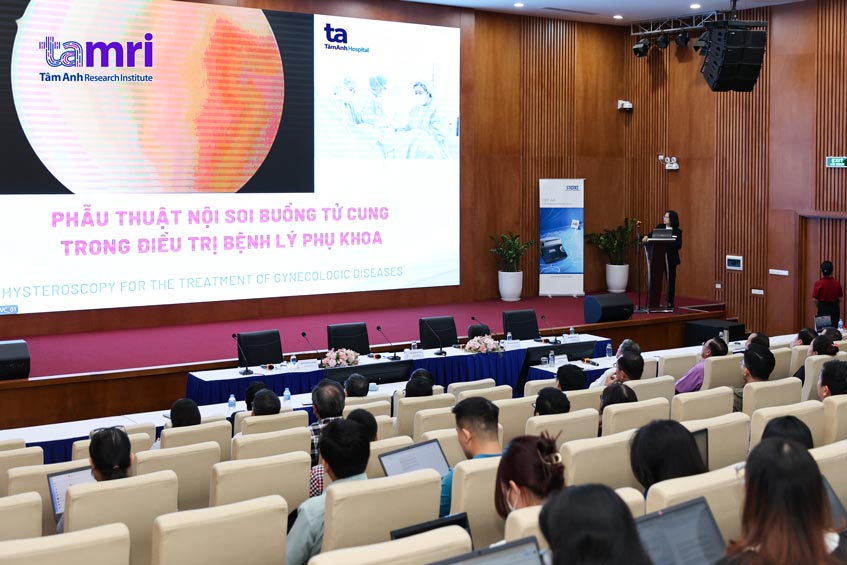
Delegates observe the live case demonstration.
Thuy had been diagnosed with secondary infertility two years ago. After delivering her first child by cesarean section, she had a miscarriage at 12 weeks and underwent a dilation and curettage. Since then, her menstrual cycles became irregular and eventually ceased. At Tam Anh General Hospital, infertility specialists determined that her husband had poor sperm motility and abnormal morphology, while Thuy had severe intrauterine adhesions, leading to amenorrhea and secondary infertility.
Nguyen Ba My Nhi, MD – Director of the Obstetrics and Gynecology Center at Tam Anh General Hospital in HCMC – explained that Thuy required hysteroscopic adhesiolysis to remove the adhesions and restore her menstrual cycle, which would improve her chances of conception.
This surgical technique has been a standard practice at Tam Anh Hospital HCMC for many years and has proven effective in treating uterine abnormalities, increasing the likelihood of natural conception, or improving the success rates of embryo transfer.
Thuy’s case was particularly challenging due to the extensive adhesions, which spanned from the cervical canal to the uterine fundus. However, since the most severe adhesions were concentrated in the middle of the uterus and her endometrial lining was largely intact, Nhi estimated a 70% chance of natural conception and the ability to carry a pregnancy to term post-surgery.
However, the possibility of natural conception would depend on the reproductive health of both partners. Thuy’s husband had poor sperm motility and a high rate of sperm abnormalities, making natural conception difficult. As a result, fertility specialists recommended IVF with embryo transfer.
Nhi highlighted the benefits of using a 4K endoscopic system with integrated magnification cameras, which provided high-resolution images of the uterine cavity. This technology allowed the surgical team to clearly visualize the adhesions and safely perform the adhesiolysis.

Nguyen Ba My Nhi (right), MD, performing the hysteroscopic surgery.
Prof. Nguyen Viet Tien, MD, PhD, noted that hysteroscopy is a highly effective technique for diagnosing and treating various intrauterine pathologies. It is indicated for procedures such as adhesiolysis, polypectomy, submucosal fibroid removal, uterine septum resection, management of endometrial hyperplasia, removal of foreign bodies, tubal cannulation, and cesarean scar repair. The current trend in surgery is to perform minimally invasive procedures that maximize therapeutic outcomes while minimizing trauma.
In the past, procedures such as uterine polypectomy, fibroid removal, and uterine septum resection required open surgery. Today, these procedures are performed using hysteroscopy, thanks to modern technology, which has significantly enhanced the safety, efficacy, and precision of these surgeries.
“Hysteroscopic adhesiolysis is a complex procedure within the field of gynecologic endoscopy. It requires extensive experience due to potential complications such as uterine perforation, hemorrhage, pulmonary edema, and the risk of recurrent adhesions,” Tien said.
Prof. Lee Chyi-Long, MD, PhD, commented that the successful surgery performed by Nhi provided valuable learning opportunities for both Vietnamese and international physicians, offering a deep understanding of the technique.
Nhi further explained that laparoscopic surgery has made significant advancements over the past few decades, particularly in the treatment of various gynecological conditions, including fetal surgery and the management of both malignant and benign diseases that affect women’s quality of life. The technique is now also widely applied to treat intrauterine adhesions, a condition that can lead to infertility or a higher risk of miscarriage.

Prof. Nguyen Viet Tien (center), MD, PhD, and other experts sharing insights at the seminar.
At the seminar, both local and international experts shared the latest developments in gynecologic endoscopy. Lee introduced a minimally invasive laparoscopic technique for vaginal reconstruction to treat vaginal agenesis, which Professor Tien described as “a crucial technique for Vietnamese doctors to master.”
Vaginal agenesis is a rare congenital condition that severely impacts reproductive and sexual function. It is often associated with uterine agenesis, with common causes including Mullerian agenesis, androgen insensitivity syndrome, Turner syndrome, Morris syndrome, and other congenital syndromes. Patients typically present with primary amenorrhea during adolescence due to the absence or underdevelopment of the vaginal canal.
Prof. Lee Chyi-Long presenting the vaginal reconstruction technique at the seminar
His innovative technique uses a peritoneal and uterine serosal flap to create a neovagina. This minimally invasive approach is simple, safe, and causes minimal trauma to the donor site, resulting in a functional neovagina that closely resembles a natural one in terms of shape and function. The newly created vaginal canal meets the necessary requirements for sexual function, including adequate size, elasticity, and moisture. This technique has proven highly effective in treating both vaginal and uterine agenesis, greatly improving patients’ quality of life.
Lee presented the results of this technique on 14 patients aged 17 to 30 (with a mean age of 24), all of whom had secondary vaginal atrophy due to Mullerian agenesis (MRKH syndrome) with normal 46XX chromosomes and normal levels of testosterone, FSH, LH, and estradiol. The procedure was 100% successful in all 14 patients, with no significant intraoperative complications or postoperative vaginal stenosis. The postoperative vaginal length ranged from 5 to 7 cm. After 2-3 months, the neovagina appeared pink and moist, and patients reported satisfactory sexual function, including the ability to achieve orgasm.
“I believe this technique will become more widely available in many countries. It’s a safe, effective, and convenient option for patients, ensuring they receive the best care possible,” he stated.
Nhi concluded that Vietnam’s gynecology field has made significant progress in mastering complex techniques, comparable to those practiced in countries such as the U.S. and Australia. Since its establishment, Tam Anh General Hospital in HCMC has successfully implemented various advanced laparoscopic procedures, including vaginal reconstruction for congenital malformations, management of hematometra due to uterine abnormalities, and treatment of intrauterine adhesions caused by abortion or curettage.
“The latest laparoscopic techniques presented by international experts at this seminar will be adopted and implemented at Tam Anh Hospital HCMC in the near future,” Nhi said.
Patient names have been changed
The seminar on “Hysteroscopy For The Treatment of Gynecologic Diseases” held on October 11, attracted international experts who presented and discussed topics such as same-day hysteroscopy (Prof. Navamol Leskul), Mullerian duct anomalies: Laparoscopy vs. Hysteroscopy (Prof. Lee Chyi-Long), hysteroscopic surgery (Prof. Nguyen Viet Tien, MD, PhD), and hysteroscopic repair of cesarean section scars (Le Ngoc Diep, MD). This seminar provided a valuable opportunity for doctors to learn about the latest advances and techniques in the field.
Tam Anh Research Institute
- Ha Noi:
- 108 Hoang Nhu Tiep, Bo De Ward, Ha Noi
- Hotline: 024 3872 3872 – 024 7106 6858
- TP.HCM:
- 2B Pho Quang Street, Ward Tan Son Hoa, Ho Chi Minh City
- Hotline: 093 180 6858 – 0287 102 6789
- Fanpage: https://www.facebook.com/ViennghiencuuTamAnh.TAMRI
- Website: tamri.vn