
The emergence of new pneumococcal strains beyond the coverage of existing vaccines necessitates that countries update to new-generation pneumococcal vaccines with broader protection. This is especially critical for children, a high-risk group for severe pneumococcal infection and disease. The 20-valent Pneumococcal Conjugate Vaccine (PCV20), with the potential to cover up to 93.9% of disease-causing serotypes in children, is anticipated to be a strategic advance. It is expected to help Vietnam proactively address epidemiological shifts and reduce the burden of pneumococcal disease and mortality.

prevention of pneumococcal disease in children
This information was shared by Associate Professor, PhD, MD Pham Quang Thai, Deputy Head of the Infectious Disease Control Department at the National Institute of Hygiene and Epidemiology. He spoke at the in-depth scientific workshop “Optimizing Prevention of Pneumococcal Disease in Children,” held simultaneously at the Tam Anh Research Institute and the Pullman Hotel in Hanoi on November 4, 2025. The workshop was organized by the Tam Anh General Hospital Group and Pfizer Inc. (USA), with professional coordination from physicians and experts in epidemiology, vaccination, and preventive medicine.
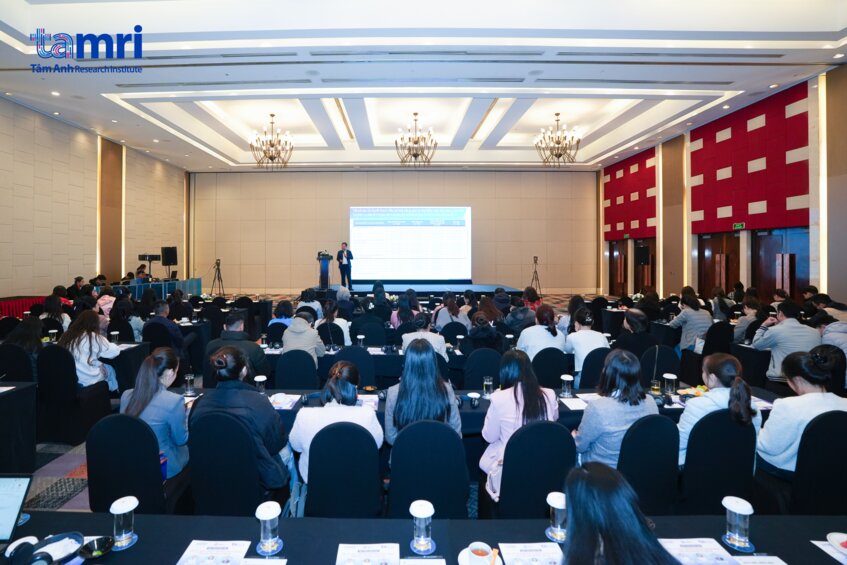
The in-depth scientific workshop ‘Optimizing the prevention of pneumococcal disease in children’, jointly organized by Tam Anh General Hospital System and Pfizer Group, attracted the participation of many leading experts in Ho Chi Minh City and Hanoi on November 4, 2025.
Opening the workshop, Associate Professor Thai stated that the pneumococcus bacterium is a leading cause of many dangerous diseases such as pneumonia, meningitis, sepsis, and otitis media. It particularly threatens young children and immunocompromised individuals. The bacterium has an outer polysaccharide capsule that helps it evade the immune system, and this capsule is also the target of current pneumococcal vaccines.
To date, scientists have identified over 100 pneumococcal serotypes, but fewer than 30 cause up to 90% of global cases. The disease-causing potential of each serotype varies; some are highly invasive and cause severe damage, so they are often prioritized in vaccine composition. Serotype distribution also changes by region, time, age, and community immunity status, and is influenced by national immunization programs, antibiotic usage habits, and socio-economic conditions.
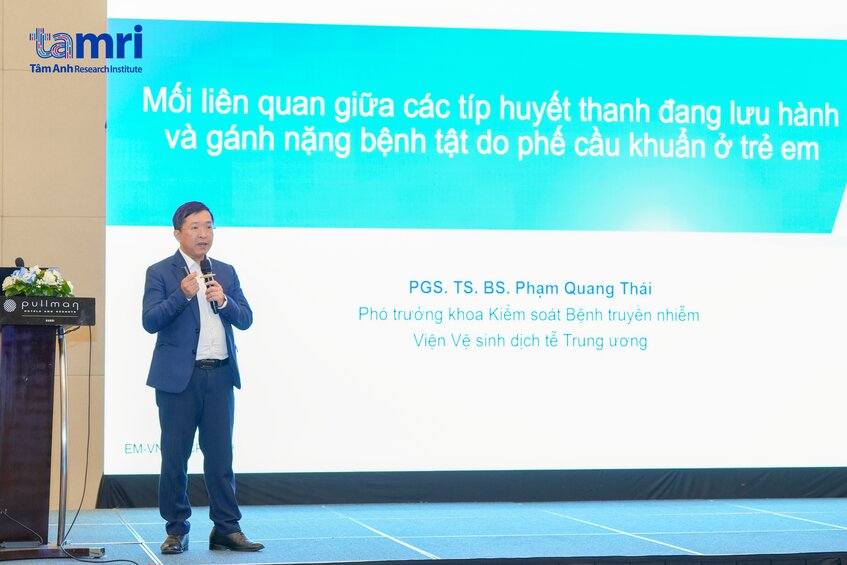
Dr. Pham Quang Thai emphasized the need for strategic vaccine selection and development tailored to each phase, based on serotype differences and clinical manifestations.
In France, surveillance studies across over 130 pediatric departments and laboratories (2011-2016) showed that serotypes 1, 7F, 3, and 19A were most frequently associated with pneumonia accompanied by bacteremia. Meanwhile, other serotypes primarily caused otitis media or non-invasive pneumonia. These results indicate that each serotype has distinct disease characteristics and clinical manifestations, forming an important basis for guiding the selection and development of suitable vaccines for specific periods and regions.
Global Challenge in Pneumococcal Disease Prevention from “serotype replacement”
In Vietnam, epidemiological studies from 2011 to the present show that pneumococcus has high diversity. Serotypes 6A/B, 19A, 23F, 19F, and 14 are the most common strains causing Invasive Pneumococcal Disease (IPD) in children. Data from the National Children’s Hospital between 2019 and 2022 recorded that 84.7% of IPD cases occurred in children under 5, the most vulnerable age group facing pneumococcus.
Meanwhile, serological analyses indicate that the pneumococcal vaccines currently circulating in Vietnam have varying coverage levels: PCV10 protects about 66%, PCV13 reaches 83%, meaning 33 – 37% of pneumococcal strains remain outside the scope of current vaccines. The appearance of these “non-vaccine serotypes” is a consequence of “serotype replacement” – as controlled strains decrease, other serotypes not covered by the vaccine increasingly become a burden.
The “serotype replacement” phenomenon has been recorded in many European countries, with the emergence of new serotypes like 8, 10A, 11A, 12F, and 15B/C, which are highly pathogenic and strongly antibiotic-resistant. In Vietnam, as pneumococcal vaccination rates increase, close monitoring of circulating serotypes becomes particularly crucial for early detection of epidemiological changes and updating appropriate immunization policies.
Consequently, many countries have switched to using PCV20 to broaden the protective spectrum and maintain long-term disease prevention effectiveness. Serological analyses show that the new-generation PCV20 vaccine can cover up to 87 – 93.9% of pneumococcal serotypes causing disease in Vietnamese children.
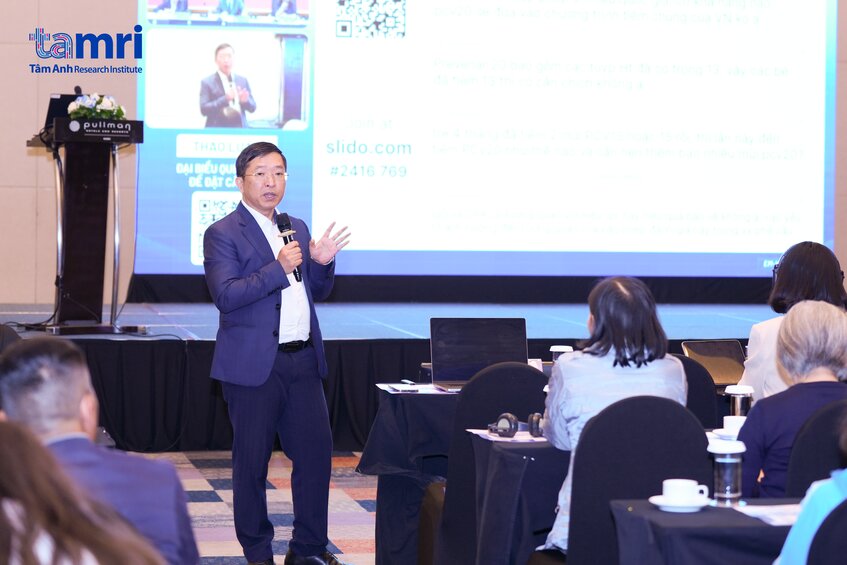
Amid Vietnam’s rising non-vaccine pneumococcal serotypes due to serotype replacement and immunity gaps, adopting next-generation vaccines with higher efficacy and broader coverage is essential.
Associate Professor Thai emphasized that while pneumococcal vaccines have significantly reduced rates of pneumonia and otitis media in young children, a portion of the disease burden persists due to emerging serotypes. PCV20 is seen as a crucial step to narrow the “immunity gap,” enhance capacity to confront “serotype replacement,” and provide more comprehensive community protection. Accordingly, Vietnam needs to proactively update to new-generation vaccines while strengthening epidemiological surveillance to ensure an effective and sustainable disease prevention strategy.
PCV20 evaluated as a new step forward in preventing pneumococcal disease in children
Supporting Associate Professor Thai’s assessment, Mr. Mark A. Fletcher, Senior Director responsible for vaccines and antiviral drugs at Pfizer, shared updated data on the effectiveness of pneumococcal conjugate vaccines and the development journey of the new-generation PCV20 vaccine for expanding protection.
He stated that Pneumococcal Conjugate Vaccines (PCVs) have demonstrated superior effectiveness in reducing the incidence of pneumonia, otitis media, and IPD in young children globally. PCV13, widely used, has significantly reduced the disease burden in many countries. Conjugate vaccines feature antigens bound to sugar molecules, helping the child’s immune system develop long-term “memory” and sustained protection for many years. This is the foundation for developing new vaccine generations like PCV20.
According to Mr. Fletcher, besides preventing disease, pneumococcal vaccination also reduces the rate of asymptomatic carriers – individuals who carry the bacteria in their respiratory tract without symptoms and can spread it to others. In the UK, after switching from PCV7 to PCV13, the carriage rate in children remained around 40%, but the dangerous pneumococcal serotypes decreased sharply, replaced by less pathogenic types. This clearly demonstrates the community impact of vaccination: when many children are protected, the whole society benefits.
Building on the legacy and success of PCV13, PCV20 is the most advanced vaccine generation today. It adds 7 new serotypes compared to PCV13, including 22F, 33F, 8, 10A, 11A, 12F, and 15B. These are prevalent, highly virulent, and strongly antibiotic-resistant serotypes circulating in many regions worldwide. This helps PCV20 cover up to 87-93.9% of pneumococcal serotypes causing disease in Vietnamese children, surpassing previous generations.
Clinical data show that PCV20 meets the stringent standards of the World Health Organization (WHO), evaluated not only by antibody concentration (ELISA) but also by opsonophagocytic activity (OPA), a test simulating the ability to kill bacteria within the body, demonstrating real-world protective efficacy.
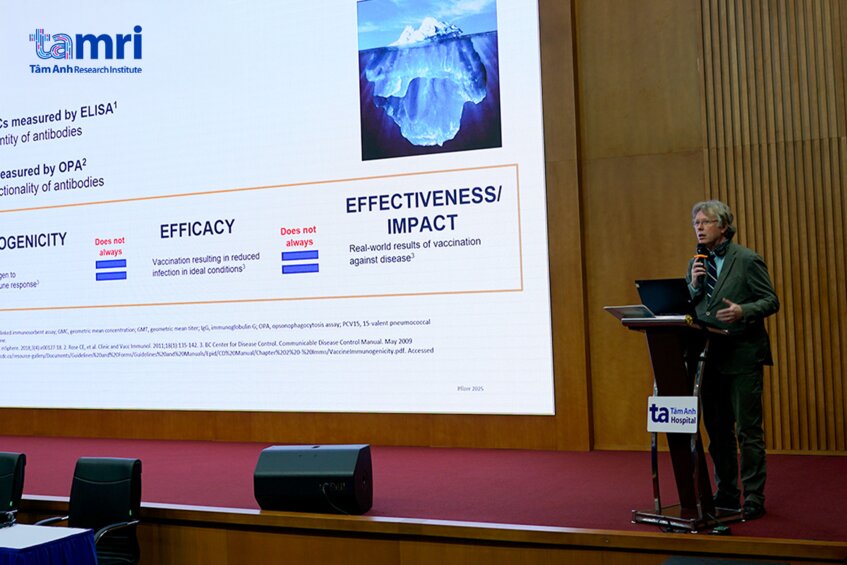
According to Mr. Fletcher, while PCV13 delivered global benefits, PCV20 elevates disease prevention to meet modern epidemiology, where pneumococcal strains continuously evolve.
“PCV20 meets international standards, builds on the success of PCV13, and offers a broader protective spectrum, helping to reduce the burden of pneumococcal disease and mortality in children worldwide,” Mr. Fletcher emphasized.
PCV20 needs expanded vaccination age, but schedules must be adapted to each country’s specifics
Following Mr. Fletcher’s sharing, Dr. Bach Thi Chinh, Medical Director of the VNVC Vaccination Center System, stated that the new-generation PCV20 vaccine is now licensed for use in children in over 40 countries, becoming an important step in preventive medicine for controlling pneumococcal disease.
After approval, PCV20 has been incorporated into the national immunization programs of 15 countries, expanding protection against increasingly diverse pneumococcal strains. By adding 7 new serotypes compared to PCV13 and PCV15, PCV20 offers higher prevention effectiveness, broader coverage, and cost optimization. In the UK, this vaccine is deployed flexibly under a 3+1 or 2+1 schedule. In Canada, PCV20 is also prioritized to replace previous types; those who received PCV13 or PCV15 can receive a subsequent PCV20 dose to enhance protection coverage.
According to Dr. Chinh, although the global trend is shifting towards PCV20, its application in each country still requires careful consideration based on epidemiological specifics, vaccination models, and affordability. “Not all international recommendations can be applied unchanged in Vietnam. When considering introducing a new vaccine into the immunization program, it’s necessary to concurrently evaluate protective effectiveness, safety, and cost factors to ensure suitability with reality,” Dr. Chinh shared.
Currently, PCV20 is approved for adults aged 18 and above in many countries, showing clear effectiveness against serotypes 3 and 9, which are common in adults. In children aged 5-17, serotypes 19F and 3 are prevalent, both included in PCV13, PCV15, and PCV20. “For young children, the 3+1 vaccination schedule is recommended to create stronger and more sustained immunity, fitting the vaccination model in Vietnam where the rate of IPD in children under 5 remains high,” Dr. Chinh emphasized.
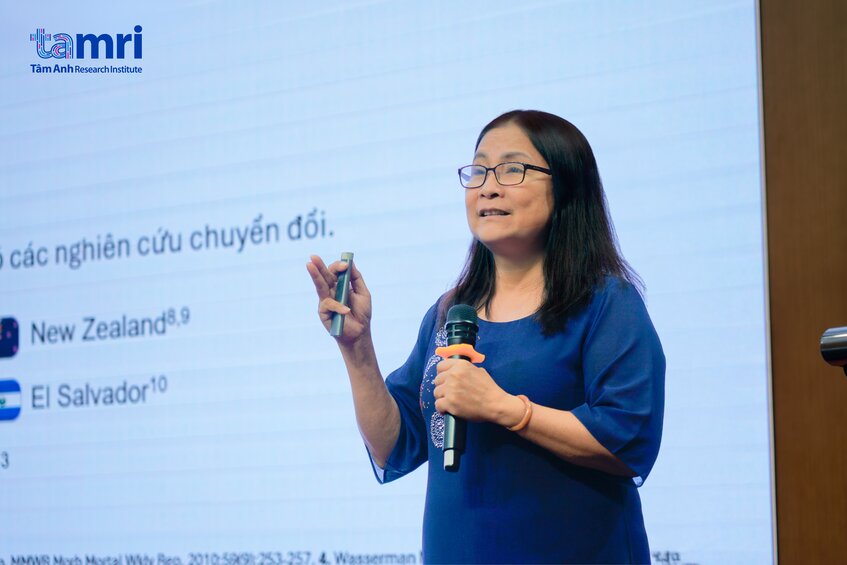
PCV20 provides stronger protection—especially against prevalent serotypes 3, 8, 15B, 15C—and induces robust immunity even in children previously vaccinated with PCV13 or PCV15.
In summary, PCV20 marks a new step in the pneumococcal disease prevention strategy, not only expanding the protective spectrum but also optimizing immune effectiveness and implementation flexibility. Updating and applying a suitable vaccination schedule for Vietnam’s conditions, based on international experience, will be a proactive and necessary move to strengthen the community immune shield and reduce the burden of pneumococcal disease and mortality, especially among young children and the elderly.
Tam Anh Research Institute
- Ha Noi:
- 108 Hoang Nhu Tiep, Bo De Ward, Ha Noi
- Hotline: 024 3872 3872 – 024 7106 6858
- TP.HCM:
- 2B Pho Quang Street, Ward Tan Son Hoa, Ho Chi Minh City
- Hotline: 093 180 6858 – 0287 102 6789
- Fanpage: https://www.facebook.com/ViennghiencuuTamAnh.TAMRI
- Website: tamri.vn