
Millions of lives were saved thanks to the “lightning-speed” global vaccination campaign. Behind this historic achievement were brilliant minds, including Professor Teresa Lambe, co-developer of the Oxford-AstraZeneca COVID-19 vaccine. On the occasion of her working visit to the Tam Anh – VNVC medical ecosystem, the Tam Anh Research Institute presents a special feature honoring these “silent heroes.”
Teresa Lambe is a Professor of Vaccinology and Immunology at the Jenner Institute, University of Oxford. For her extraordinary contributions to science, she was awarded the George Sigerson Award by the Biological Society at University College Dublin (UCD) on March 24, 2022.
During her award ceremony, Professor Lambe detailed the intense journey she and her team underwent to develop the Oxford-AstraZeneca vaccine. In an interview with The University Observer, she provided deep insights into her decade-long research at Oxford and how that technology became the foundation for a vaccine that saved millions globally.

Prof. Teresa Lambe spends time with colleagues and students discussing the development of viral vectors. (Photo: LinkedIn Prof. Teresa Lambe)
Professor Lambe graduated from UCD with a Bachelor of Science (BSc) in Molecular Biology and Biomedical Science, completing a double major in Pharmacology and Genetics in 1997 before earning her PhD in 2002. She often credits the diversity of her dual-major program for allowing her to pursue multiple passions.
Professor Lambe shared: “After completing my PhD, I wanted to go abroad. At that time, I began to develop an interest in immunology, the study of the immune system, even though my work at the time wasn’t closely related to that field. However, I was fortunate to secure an opportunity to work with Professor Richard Cornall and Professor John Bell at the University of Oxford.”
“At UCD, we have always been strong in applying new technologies and staying open to innovation,” she noted. This mindset drove her decision to pivot toward “applied immunology.” In the early stages, she collaborated with Professors Cornall and Bell to research autoimmune diseases, conducting extensive basic science to unravel the fundamental mechanisms of disease onset.
Despite her fascination with autoimmunity, Professor Lambe found herself yearning for more translational and applied research. “I am a bit impatient and always prefer to see a real-world impact. While the work was fascinating and I was truly passionate about understanding basic biological mechanisms, I couldn’t always see the practical outcomes clearly enough.” This realization inspired her transition into vaccine research.
“Vaccines have a global impact. When an opportunity arose in this field about 13 or 14 years ago, I decided to shift my focus to vaccine R&D. Fundamentally, I love discovering how things work, and then seeing firsthand how those discoveries make a difference,” she added, reflecting on her professional compass.
To her, research is not just about pushing the boundaries of knowledge but about delivering tangible benefits to humanity. Creating visible, real-world value is what she considers the “greatest reward.”
Since that turning point, Professor Lambe has remained dedicated to her work at Oxford. She considers both Ireland and Oxford as her homes. For her, Oxford possesses a unique rhythm unlike any other city. Its academic and research community creates a vibrant diversity, a microcosm in the heart of England that offers the chance to engage with people from all walks of life and cultures.
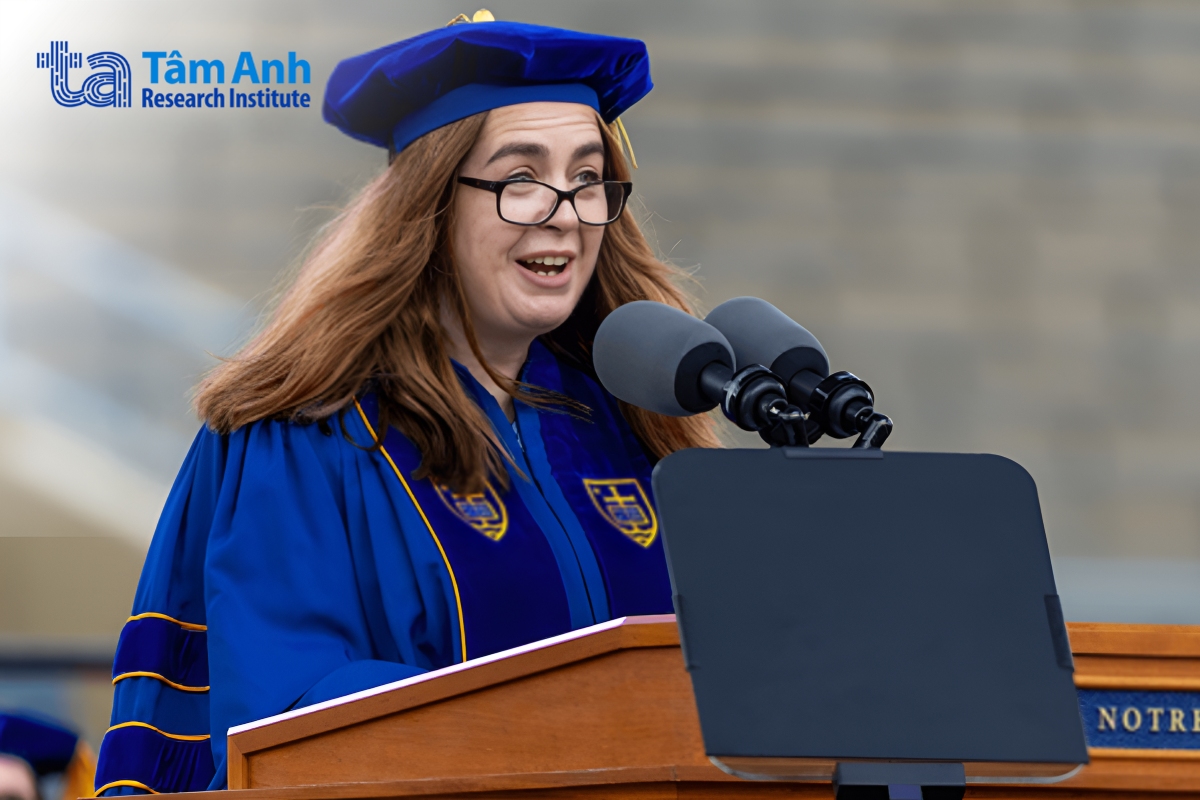
Prof. Teresa Lambe speaking at the 2025 Graduate Commencement at the University of Notre Dame, urging graduates to live with purpose. (Photo: Notre Dame Portal)
During her time at Oxford, Professor Lambe and her team focused on developing vaccines for a wide range of pathogens. Over the years, the team, alongside Professor Dame Sarah Gilbert, developed a “platform technology” utilizing adenoviruses. Adenoviruses are a group of viruses that can cause infections in both humans and animals, including chimpanzees. These specific adenoviruses are weakened and modified so that they cannot cause harm to humans.
To develop a vaccine, Professor Lambe and her research team used a meticulously selected and modified chimpanzee-derived adenovirus. The mechanism involves inserting the genetic code of a target pathogen into the adenovirus. Acting as a “carrier,” the virus enters the body, where the genetic code stimulates cells to produce specific proteins. Consequently, the immune system easily recognizes these proteins and automatically triggers a defense against the pathogen.
Speaking at the award ceremony, Professor Lambe explained that the team already possessed this “platform technology,” having successfully applied it multiple times to produce various vaccines. Accordingly, the development of any new vaccine begins with identifying the core characteristics of a pathogen to integrate them into the adenovirus.
In the case of SARS-CoV-2, scientists extracted the genetic sequence of the spike protein, the “blueprint” and integrated it into the adenovirus. The Professor likened the virus to a “Trojan Horse,” serving as a vehicle to transport the SARS-CoV-2 spike protein’s genetic code into the cells. As soon as the spike protein is synthesized within the body, the immune system immediately recognizes the foreign element and activates a defensive chain reaction.
Recalling the moment they began designing the vaccine, Professor Lambe noted that she received crucial data on a Saturday morning (January 11, 2020). Work accelerated rapidly; just two days later, on Monday (January 13), the team had finalized the formula for synthesizing the SARS-CoV-2 spike protein.
In her speech, she shared that the pandemic was an incredibly harsh period for everyone, including her team. When the project first launched, the research group was modest in size. However, through extraordinary effort, they successfully obtained evidence that the vaccine could stimulate immunity just nine days after the first preclinical study.
Despite these promising early signals, the team could not yet confirm the vaccine’s actual protective efficacy. Consequently, human clinical trials were fast-tracked. Professor Lambe emphasized that efficacy cannot be predicted, making clinical trials mandatory to find the most accurate answers.
Professor Lambe shared that the question she is most frequently asked is what enabled the team to develop the vaccine at record speed. She explained that instead of following the traditional sequential steps from design and preclinical research to clinical trials, the team ran these phases almost in parallel. This “lightning speed” was further amplified by several decisive factors.
When asked about the most critical factor, she emphasized it was the spirit of dedication. Typically in the research world, experts tend to work independently within narrow specialties or focus on specific diseases, inadvertently creating invisible barriers. However, when the international vaccine project was initiated, all those silos and disciplinary silos completely vanished. The entire team contributed their efforts, ready to do whatever was possible to lead humanity out of the “tragedy” of 2020.

Oxford experts and Tam Anh Research Institute specialists discussing “Comprehensive Vaccine Capacity: From Research to Production.” (Photo: Tam Anh Research Institute)
Another key factor, according to Professor Lambe, was the team’s early and heartfelt investment in “platform technology.” This was the fruit of years dedicated to fundamental research, during which the team even persevered through periods of depleted funding, meticulously saving every resource to sustain their mission.
In her interview, Professor Lambe revealed that there was no formal call to arms; rather, there was a growing collective realization that they needed to act and act fast. Alongside her team and global collaborators, she worked tirelessly to ensure the vaccine’s timely release.
She and many others sacrificed precious time with their families, enduring chronic sleep deprivation and working through the night to ensure the project’s success. Despite the distance from her loved ones, she shared that there was hardly any time to dwell on it. Every day followed a relentless pattern: wake up, dive into work, and maintain absolute focus on the goal. They pushed forward, setting everything else aside, driven by the vital responsibility to accelerate the vaccine’s completion.
The Professor admitted it is difficult to fully describe that period, as the pandemic brought vastly different experiences to everyone. For the research team specifically, life became a singular cycle of waking up, going to work, and returning home.
It was the profound awareness of the risks and the potential impact of the vaccine that empowered Professor Lambe and her team to navigate the most stressful phases of 2020 and 2021. The boundary between weekdays and weekends ceased to exist. The team became consumed by their work, knowing that every detail was critical. There was no room for error, as the final outcome would bring tangible benefits to the world.
Beyond the pressure of the timeline, the research group had to confront the equally distressing issue of misinformation. Professor Lambe shared that the team was constantly “battling” false narratives. The consequence of this misinformation was widespread confusion and skepticism, which led to declining vaccination rates in many countries.
A primary motivation for the team was the desire to create a product accessible to everyone globally at an affordable cost. Nevertheless, she remains deeply concerned by the reality of vaccine inequality, where high-income nations were consistently prioritized for distribution.
When discussing solutions to combat fake news, she makes a clear distinction between those who are hesitant or undecided and those who are staunchly anti-vaccine. For the hesitant, the core issue usually lies in fear and uncertainty. In these cases, open dialogue can help dismantle barriers. She emphasized the importance of empathetic listening. Since one-way communication is no longer effective, it is essential to sincerely listen to the public’s legitimate concerns. Instead of inundating people with dry statistics, they should be encouraged to voice their anxieties, which should then be met with empathy and genuine care. Through the pandemic, Professor Lambe realized that the scientific community may have underestimated the importance of public communication, highlighting a real need for more training programs to improve this vital work.
The pandemic has clearly exposed the destructive power of fake news on “medical trust.” Vaccine hesitancy was not only directed at the Oxford-AstraZeneca vaccine but spread to other COVID-19 vaccines as well. However, reality has proven that vaccines significantly reduce hospitalizations and prevent deaths. Without vaccines, humanity might never have found a way out of the pandemic.
The tireless research efforts of Professor Lambe, her colleagues, and scientists worldwide have laid a critical foundation for responding to future public health emergencies. She notes that people often have a psychological tendency to avoid or deny that a tragedy could happen to them. However, rather than wondering if another pandemic will return, the correct mindset is to be prepared for the moment it inevitably does. Therefore, sustaining and accelerating investment in vaccine research and development is a matter of vital survival.
In her closing remarks, Professor Lambe expressed her deep gratitude to University College Dublin (UCD), the institution that provided her academic foundation and played a pivotal role in her career. The people she met and the open-mindedness nurtured at this university became the invaluable assets that helped her achieve today’s successes.
Through her relentless dedication, Professor Lambe has become a powerful source of inspiration for young scientists across the globe. Her message is clear: no matter how small your starting point, everyone can reach their dreams. This world is filled with endless opportunities so go out there boldly, give yourself the chance to seize them, and never be afraid of making mistakes.
Tam Anh Research Institute
- Ha Noi:
- 108 Hoang Nhu Tiep, Bo De Ward, Ha Noi
- Hotline: 024 3872 3872 – 024 7106 6858
- TP.HCM:
- 2B Pho Quang Street, Ward Tan Son Hoa, Ho Chi Minh City
- Hotline: 093 180 6858 – 0287 102 6789
- Fanpage: https://www.facebook.com/ViennghiencuuTamAnh.TAMRI
- Website: tamri.vn