

Obesity rates are rising rapidly worldwide and across the region, making it a serious chronic health condition. Challenges in weight management during obesity treatment stem from weight regain and limited patient engagement in treatment.
Experts shared these insights during the scientific symposium “Challenges in weight management: from failure to solutions,” held at Tam Anh General Hospital in Ho Chi Minh City (HCMC) at midday on November 19.
Obesity is becoming a global pandemic. According to the World Health Organization (WHO), at least 2.8 million people die each year from being overweight or obese. An estimated 35.8 million people (2.3%) worldwide are affected by the disease burden associated with overweight or obesity. Lam Van Hoang, MD, PhD, Head of the Department of Endocrinology and Diabetes at Tam Anh General Hospital Group in HCMC, noted that analyzing the reasons behind unsuccessful weight loss and identifying effective solutions are essential to developing safe, effective, and sustainable weight management strategies.

Dr. Lam Van Hoang discusses the challenges of long-term weight management for people who are overweight or obese.
Drawing on a range of clinical cases involving both successful and unsuccessful weight loss treatment, Pham Thi Thu Ha, MD, from the Department of Endocrinology and Diabetes at Tam Anh General Hospital Group in HCMC, explained that weight management involves three key challenges: biological challenges (as the body resists weight loss and activates mechanisms that promote weight regain), clinical challenges (patients with the same diagnosis receiving the same medication may experience different complications, treatment responses, and tolerability), and behavioral challenges (few people are able to maintain long-term lifestyle changes).
Many patients lose weight during treatment but regain it after stopping medication on their own or failing to make lasting lifestyle and behavioral changes. Dr. Ha explained that when patients discontinue treatment on their own, their bodies may not yet have adapted to their new habits. As a result, biological mechanisms that defend the body’s previous weight can trigger increased appetite and promote weight regain. Notably, body fat can increase even when overall body weight remains unchanged. When patients stop taking medication on their own, fail to follow recommended nutrition and exercise plans, or follow them inconsistently, weight loss outcomes may be limited or treatment may fail altogether.

Dr. Pham Thi Thu Ha presents weight management solutions based on clinical cases of both successful and unsuccessful treatment. Photo: Tam Anh General Hospital.
To address these challenges, physicians need to comprehensively assess each patient’s underlying health conditions, motivation, and barriers to treatment; establish shared goals; and develop individualized multimodal treatment plans with progress evaluated at defined intervals. They should also provide ongoing support, intervene early before patients discontinue treatment, and ensure long-term monitoring and maintenance.
Highlighting dietary patterns in obesity treatment, Vo Tran Nhu Thao, MD, from the Department of Endocrinology and Diabetes at Tam Anh General Hospital Group in HCMC, identified several common eating behaviors among people who are overweight or obese, including eating too quickly, consuming large amounts of ultra-processed foods, concentrating caloric intake in the evening, and consuming excess calories while lacking essential micronutrients.
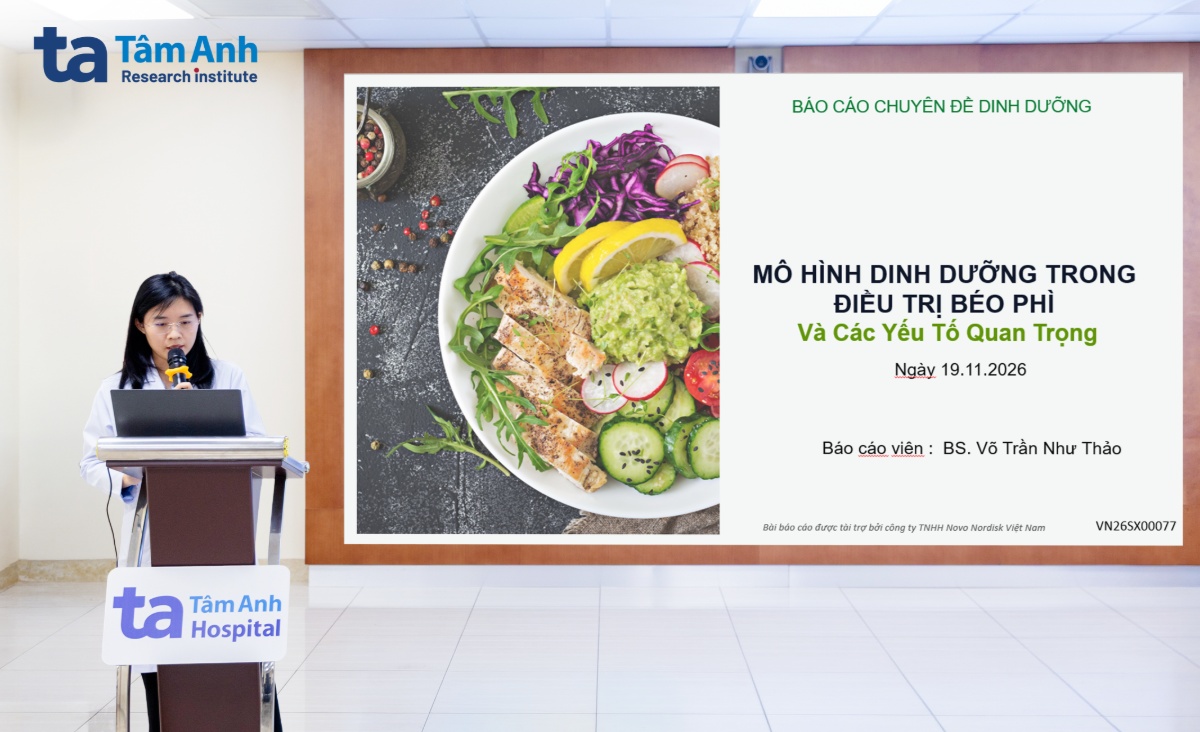
Dr. Vo Tran Nhu Thao presents dietary patterns in obesity treatment. Photo: Tam Anh General Hospital.
To improve meal quality, people who are overweight or obese should increase their intake of micronutrient-rich foods, including vegetables, fresh fruits, nuts, legumes, and lean proteins; reduce refined carbohydrates, sugary beverages, processed foods, and ultra-processed products; and consider supplementing with vitamin D, calcium, vitamin B12, or multivitamins when their food intake is very low.
For patients experiencing poor appetite or reduced food intake due to the side effects of weight-loss medications, eating smaller, more frequent meals and choosing soft, liquid, and easy-to-swallow foods while ensuring adequate protein intake are recommended. Weight loss does not always mean fat loss: approximately 20% to 30% of lost body weight may come from lean body mass. Therefore, nutritional plans should prioritize adequate protein and micronutrient intake, combined with appropriate resistance training, to preserve muscle mass, minimize metabolic decline, and reduce the risk of weight regain.
Lam Van Hoang, MD, PhD, emphasized that obesity is a chronic disease requiring early and long-term treatment. Success in treating overweight and obesity is measured not only by the number of kilograms lost but also by the ability to reduce excess body fat, preserve muscle mass, improve metabolic health, and maintain sustainable results.
VIỆN NGHIÊN CỨU TÂM ANH
- Hà Nội:
- 108 Hoàng Như Tiếp, Phường Bồ Đề, TP.Hà Nội
- Hotline: 024 3872 3872 – 024 7106 6858
- TP.HCM:
- 2B Phổ Quang, Phường Tân Sơn Hòa, TP.Hồ Chí Minh
- Hotline: 093 180 6858 – 0287 102 6789
- Fanpage: https://www.facebook.com/ViennghiencuuTamAnh.TAMRI
- Website: tamri.vn